Showing posts with label tradition. Show all posts

Friday, August 1, 2014

The Ohio State Marching Band: The underbelly of tradition and ritual

I've written several times about the role of ritual and tradition in higher education.  I'm a big believer in the miseducative if they marginalize certain members of the community, silence diverse perspectives, or send mixed or conflicting messages about institutional values.
power of traditions to connect members of a community, communicate key community values, and facilitate learning.  However, traditions and rituals also have the potential to be

Over the last week, +The Ohio State University Marching Band has received a great deal of attention surrounding some of the rituals and traditions that are, allegedly, part of the culture of the band in Columbus. On one side of the debate OSU administrators claim the band has developed a hyper-sexualized culture, while others argue that the practices in question were both harmless and unifying.

While I'm not sure how much recently-fired band director Jonathan Waters had to do with the culture and whether his firing was justified (he claims he was working on changing the culture of the band, but wasn't given sufficient time to do so), I will say very emphatically that I do not endorse the types of hazing practices that were well documented at OSU.  There is a very vocal contingent of band alumni that will disagree with me who disagree with me.  A group of 15 former band members (mostly women) marched on OSU's campus earlier this week to protest Waters's firing and sing the praises of the OSU Marching Band.  In her statement to the press she claims to represent the "women's side" of the issue and goes on to say that the actions of band members were appropriate because they "acted like college students."

Cohen's statements represent one of the fundamental dangers with any tradition or ritual.  In asserting that she and her 14 companions represent the "women's side," Cohen fails to acknowledge that her views do not necessarily represent those of the hundreds of other current and former band members.  It's a bit laughable for her to claim that a group of 15 people represent anything other than a very narrow perspective on a very complex issue.  Additionally, she makes a gross overgeneralization in equating "acting like a college student" with the behaviors outlined in OSU's report of the problematic practices taking place among band members.

While traditions and rituals are ideally meant to have a unifying effect within an organization, claims that hazing practices achieve this outcome are naive.  Furthermore, claims that hazing is an acceptable practice that unites a community are always made by a particular segment of that community:  those with privilege and power.  It's safe to say that Cohen was part of the inner circle during her time as a band member.  She didn't have a problem with the practices because they didn't marginalize her, silence her voice, or make her feel unsafe.  But, there is another segment of the OSU Marching Band who feel very differently about these practices and I'll bet the farm that there are more than 15 of them.

In a comment on a post I wrote nearly four years ago, a good friend and colleague +gary daynes pointed out that one of the characteristics of a ritual is that it contains multiple meanings.  And, this is what is often looked over when those in power institute rituals, even well intentioned rituals.  OSU's hazing rituals hold multiple meanings for members of the band.  For some, those meanings include fun, unity, and feelings of belonging.  For others (those whose voice is silenced when these rituals become formalized and part of the culture), these practices mean shame, marginalization, fear, and immorality.

I say this as someone who, 15 years ago, would have sided with Cohen and her group.  During my freshman year of college, I was hazed as part of my initiation to the men's soccer team.  While it was uncomfortable and a little embarrassing for me, I wasn't overly bothered by it because I wasn't on the margins of the team--the team leaders liked me and I didn't feel threatened (it was also fairly mild as far as hazings go).  But, I clearly remember two of my teammates who were very shook up by what went on.  And, it's no coincidence that they were the two members of the team who, even before the hazing, were on the outside looking in (it's also no surprise that they left the team after their freshman year).  From where I sit now, and as someone who has hopefully developed a bit of appreciation for diversity, I see how divisive that hazing was.  

Ritual and tradition should always be a part of campus communities.  But, institutional leaders (like Jonathan Waters) have a responsibility to (a) ensure that campus rituals do indeed have a unifying effect and (b) educate members of the community (especially students) about what constitutes a truly unifying ritual.  As higher education professionals, one of the outcomes we claim to be promoting for students is an appreciation for diverse perspectives.  Those advocating for the appropriateness of OSU's hazing practices clearly haven't learned that lesson.

Friday, May 9, 2014

Institutional Innovation: Campus-wide improvement efforts, or lifeboats for a sinking ship?

The pressure for institutions of higher education to be "innovative" is rapidly growing.  While there are a few holdouts, clinging to romantic notions of what universities "should" be, it's commonly understood that the landscape of higher education is shifting dramatically.  Consequently, the "traditional" way of doing things won't be enough for institutions to remain viable into the future.

One of the most frequently critiqued "traditions" of the academy is the general education experience of undergraduate students.  This is particularly true for large research institutions where undergrads, especially first-year students, commonly find themselves in large, impersonal lecture courses or trying to make sense of complex general education 
requirements that leave students feeling fragmented and disoriented.

In response to these critiques, institutions frequently engage in small-scale innovations that are touted as improved alternatives to the typical general education experience.  The most well-known (and oldest) brand of these innovations are Honors programs, where students are promised things like "an unusally rich and challenging experience for capable and motivated undergraduate students" (from the description of BYU's Honors Program that appears on the Undergraduate Education homepage).  Another example from BYU is our new "Mosaic" approach to general education, offered as a program that "works for YOU and YOUR goals" and as a better approach than taking "random classes."  Finally, our most recent innovation--a series of three interdisciplinary general education courses titled "Unexpected Connections" and taught by administrators in the College of Undergraduate Education.  The goal of these courses, taught in close collaboration with the BYU Honors program, is to give students a "broader and more interdisciplinary education by making connections between . . . different disciplines."

At first glance, these "innovations" all seem fantastic.  What could be better than an "unusally rich" experience? A general education program that meets MY goals and that moves away from me having to take "random classes?"  Or, a broad and interdisciplinary education?  Isn't this what we're all striving for at our institutions?

Precisely. The undergraduate experience is assumed to be providing all students with these types of experiences.  But, ironically, when institutions emphasize curricular innovations like those above, they are in the words of Murray Sperber, "pointing the way to their lifeboats" (i.e. these small pockets of innovation), while inadvertently signalling that those who don't make it into the boats are, sadly, part of a sinking ship.  As innovative, enriching, and engaging as these lifeboats might be, they don't in any way compensate for the poverty of the ordinary experience.  This is the problem with innovations in higher education--they are often used as a camouflage for more wide-spread failures.  

So, what to do?  I'm not advocating for institutions to stop innovating.  Improvements to the general education experience, as small-scale as they may be, are a good thing.  But, only if they lead to one of two outcomes.

One path is to provide enough "lifeboats" that everyone is saved from the sinking ship.  In practice, this would mean allowing diverse, small-scale innovations to continue to occur on the margins, without worrying about wholesale changes to the undergraduate experience.  While it may be naive, an institution could make the argument that they have provided enough different "niche" opportunities that any student can have their "honors" experience, whether that's in a formal honors program, through participating in undergraduate research, or serving in some sort of peer leadership role (i.e. as a resident assistant, peer mentor, or peer advisor).  For this "many lifeboat" plan to work, it's imperative that campuses provide some means of helping each student find the lifeboat they'll need.  Providing adequate advisement resources and personnel seems like a good start, but this could be accomplished in other ways as well.  Without an intentional and strategic plan for connecting students with these niche opportunities, chances are only the most prepared and resourced students will benefit.

The second approach to more ethical innovation is one that moves away from providing "lifeboats" and focuses on improving the "ship."  From this perspective, innovation becomes a learning exercise for the institution at-large.  While the innovations and improvements may begin on the margins, the perennial goal is always to use these "experiments" to eventually make more widespread changes that impact all the students on campus.  The challenge here is making sure that innovations don't live and die on the margins, but that the best innovations are identified, rigorously evaluated, and then thoughtfully scaled up.

For institutions to innovate in the ways I've described here, they'll need both honesty and patience.  The honesty to admit that a handful of lifeboats aren't enough to save a sinking ship, and the patience to see worthwhile innovations through to the point that everyone, not just the privileged few who find their way to the lifeboats, benefits.


Friday, March 28, 2014

A potential game changer for college sports: Unionized athletes

Kain Colter, the outgoing quarterback at Northerwestern
Yesterday, Michael Tarm of the Associated Press reported on the National Labor Relations Board's ruling Northwestern University can create the first-ever union of college athletes.  While the ruling only applies to Northwestern, it has the potential to dramatically alter the landscape of college athletics, athletic department budgets, and the experience of student-athletes.
that football players at

At the core of the decision was the question of whether football players at Northwestern qualify as "employees" of the university?  In his ruling, Peter Sung Ohr, the National Labor Relations Board (NLRB) regional director argued that the players meet the two major criteria for employees:  first, they are "compensated" through athletic scholarships and, secondly, they are under the strict and direct managerial control of coaches and athletic administrators.  In his 24-page decision, he went on to say that players are "identified and recruited . . . because of their football prowess and not because of their academic achievement," citing a lack of any real evidence that scholarship players are ever allowed to put academics first by missing games or practices in order to attend to academic obligations.

These are murky waters that Northwestern's players union, as well as the NCAA and all of its member institutions, are wading into.  College sports have long been held up as a model of amateurism and are viewed by many as the pure and wholesome alternative to the greed and commercialism of professional sports (this is particularly true at this time of year when the country is caught up in the romance and drama of the NCAA men's basketball tournament with its narratives of the underdog school and players who play for the love of the game).  So, if unionizing were to become widespread among college athletes, fans may not be so quick to view them as the noble, self-sacrificing "student-athletes" that are portrayed in the NCAA's recent marketing campaigns.

At the same time, Kain Colter (a former Northwestern quarterback,who has been the public face and leader of the push), his teammates, and their supporters have a fair argument.  For athletes participating in "revenue sports" (e.g. football and men's basketball), their lives look a lot like a professional athlete in that their in-season time commitment approaches that of a full-time employee, they do receive compensation (though minimal) for their involvement, and their lives are very highly structured by coaches who dictate how they spend their time and what other activities they are involved in.  In short, they look a lot like institutional employees, but without many of the protections that an employee in another part of the institution might have (e.g. coverage of "work-related" medical expenses).

At this point, the goals of the College Athletes Players Association (CAPA), which is the group that will represent the union, are to ensure coverage of sports-related medical expenses, advocate for policy changes that will help to reduce head injuries, and to begin discussions about the possibility of allowing college athletes to pursue commercial sponsorships.  It's this last one that will raise eyebrows, again, because it calls into question the notion of amateurism that has made college athletics palatable, even when its dark side has reared its head.

For the time being, this ruling only effects private institutions, and only football and men's basketball players on those campuses.  But, like ESPN legal analyst Lester Munson has pointed out (+Lester Munson), the ruling could quickly snowball to effect a much broader range of institutions.

There is a fundamental tension at the heart of this issue between protecting the rights of athletes and preserving the romanticism of amateur college athletes.  Is this the beginning of the end for amateurism in college sports?  Just a necessary protection for college athletes?  Which side of the fence do you come down on?  Which side of the issue should be more heavily weighted?


Friday, March 7, 2014

The importance of the CSO (Chief Storytelling Officer)

I spent the last two days with a group of public school teachers, counselors, and administrators.  For the last
six months, I've been privileged to meet with them about once a month to be part of discussions surrounding important issues in education.  This week's retreat was focused on the notion of stewardship in schools and the need for educators to hold a commitment and investment in the entire school community, as opposed to what happens in their classroom.  For me, the highlight of the two days was hearing two key stories that are at the heart of the work we were doing together.  

The first story came from Steve Baugh, who is a former school superintendent in Utah and now the Executive Director of the BYU-Public School Partnership and Center for the Improvement of Teacher Education and Schooling (CITES).  Paul's purpose was to familiarize us all with the story of CITES, and more specifically, the Associates Program that we are all participating in.  He described what led to the formation of the partnership, the evolution of its core commitments, and the purposes behind the Associates Program.  Hearing this story from Steve, who has been involved with the partnership in one form or another for the last two decades, was infinitely more impactful than reading about it in a brochure or on a website (which I have done multiple times).  When he finished his story, I felt a renewed sense of purpose, pride at having been asked to participate, and a commitment to fully engaging in the process.

The second story was told by Paul Sweat, the former principal of Wasatch High School.  Paul was the principal at Wasatch during two key events:  the move from the "old high school" to the "new building" and the 100 year anniversary of the opening of the first high school in 1908.  From what I can tell, Paul's most significant contribution to the school and the surrounding community was taking what was a highly emotionally-charged, politicized, and potentially controversial transition into a new building and using that process as a means of uniting both the school community and the surrounding community of Heber Valley.  His story described the process of moving into the new school, incorporating elements of the "old school" and its values into the new building, and skillfully generating support from nearly everyone involved, including current students, parents, alumni, and community members.  I've never seen a school or administrator be so intentional or strategic about anything--it was inspiring and instructive.

Steve and Paul are what I call Chief Storytelling Officers or CSOs.  In addition to the duties outlined in their job descriptions as administrators in their organizations, they play an incredibly (yet underappreciated and often unrecognized) role in ensuring that the wisdom, legacy, and values of their organizations are understood and appreciated by others.  Clearly, to be a CSO requires skill in story-telling (which I'll get to), but it's also a lot more:

1.  Deep history and vast experience.  Neither Steve nor Paul have been around from the beginning, but they've been around long enough that they have a rich institutional memory.  Steve has been involved as a teacher, administrator, or faculty member in the partnership for 44 years.  During that time he's been a close observer of the development and evolution of the partnership, positioning him to tell its story well.  In Paul's case, he has become a student of the history of his district, both by doing traditional research and spending hours and hours in conversation with others who have been around a lot longer than he has.  As a result, he knows the story of Wasatch High School and it means something to him (he had to hold back tears a number of times yesterday as he shared vignettes of the sacrifice and commitment that others have made over the years as teachers, coaches, benefactors, etc.).  A CSO knows the meta-story of his or her place because he or she has lived it, researched it, and listened the hundreds of micro-stories from others across all levels of the organization.

2.  Credibility and Respect.  Because of their experience, Steve and Paul have street cred, which means that when they tell their story, others listen.  Steve has a natural advantage because he's been around a long time and that, in and of itself, brings respect and credibility.  In Paul's case, his credibility has come through the hard work he's done to learn the story and his demonstrated abilities in bringing people together for a shared purpose.  CSOs can't just be good story-tellers, they have to have been successful in their other roles, be it as the CFO, superintendent, director of HR, or whatever it is they're job description says they're supposed to be doing.  That success buys them the story-telling capital they need for people to listen to what they have to say.

3.  Story-telling Chops.  Steve and Paul both told their stories in very different ways, but in both cases it was effective.  Steve spoke from hand-written notes and had no visual supports, which some would say is a big no-no.  But, his sincerity and humility are disarming.  I felt like I was listening to the grandfather of CITES tell me a story that I'd heard before, but that I couldn't stop listening to.  Paul used visual images really well, from pictures of the first high school and how the new building incorporated some of its architectural elements, to the new school seal,, to the mural that was created by an alum (who also happens to be a respected artist) to visually represent the story of the first 100 years of WHS.  The images he shared, sprinkled with vignettes about key events and characters from the school's history, left me wanting to quit my job at BYU and go to work at the High School, and I've never even stepped foot in it.  

Although I'm not an employee of Wasatch County School District or of the McKay School of Education, hearing these stories left me feeling a sense of stewardship for what happens in Wasatch County Schools.  I care about the students there and want to be a part of the learning that goes on in their classrooms.  That means Steve and Paul both played their role as CSOs very well.  The stories they told helped me understand and feel connected to the legacy, culture, and purposes of their organizations.

Steve retires this year and Paul has moved on to a position at the district level.  There is an inherent risk that their stories will be forgotten.  If that happens, both the McKay School and the District will have lost a tremendous asset.  In fact, yesterday after Paul's presentation I asked him whether students and teachers at the high school knew much of what he had shared with us.  He mentioned that there is an orientation for new students in which some of the stories are shared, but also acknowledged that since he has left the HS, a lot of the stories have been forgotten.

Individuals have short memories.  Organizations, particularly those with high degree of turnover, have even shorter memories.  One of the dangers, any organization needs to be aware of and avoid, is letting CSOs go unnoticed, or worse, letting them move on without imparting their stories to new CSOs.   

So, whether you're a family, a business, a school, or a church congregation, you need to be asking yourself a set of questions relating to your stories:

  • What are the key stories that need to be told?
  • Who are the CSOs who can tell them?
  • Who will be the new CSOs?
  • How do we prepare them?


What concerns me is that neither the McKay School or the District seem to recognize Steve and Paul's roles as CSOs.  

Friday, February 28, 2014

Is Higher Education Rehabilitative? (Read: Should inmates receive a college education?)

This morning, Inside Higher Ed reported on New York Governor +Andrew Cuomo's plan to provide the option of a college education to inmates in about 10 of New York's state prisons.  Not surprisingly, it's become a hot topic.  Opponents of the plan are raising questions about the fairness of providing a free college education to "crooks," while New York's law-abiding citizens are struggling to find ways to finance higher education.  And, in one of the more bone-headed things I've read recently, State Assemblyman +Jim Tedisco claimed that the program would just produce "smarter criminals."  Advocates for Cuomo's proposal argue that investing in higher education for inmates will reduce costs in the long run by lowering recidivism rates (a claim backed up by loads of research, as well as the state of Indiana's long-running case study).

At the core of this particular issue are two questions that academia has grappled with for decades.  First, is the question of whether or not a college education is transformative (or, in this case, rehabilitative).  The assumption made by Cuomo and the backers of his proposal is that the college experience, whether that's delivered in a traditional university setting or behind bars, changes learners in fundamental ways.  Not only do they acquire new knowledge and skill, but they come to see and interact with the world in new (and, we assume, more productive) ways.

This belief in the transformative nature of education is at the foundation of the second question embedded in the current debate, which is whether a society benefits when its individual citizens are educated.  For the most part, the United States and virtually every other democratic society have, to one degree or another, agreed that an educated citizenry is a better citizenry.  So, we do things like subsidize the entire cost of public education for young children, and a percentage of the cost for those pursuing higher education at particular institutions (hence, the State College).

In sum, the vast majority of Americans believe at some level that higher education is both transformative and democratically beneficial.  So, it's a bit ironic that some of those same folks are now questioning a proposal based on those very assumptions.  While the current economic state of higher education funding, and the student debt crisis, make the thought of paying for an inmates college education a bit uncomfortable, my argument is that it is clearly in line with the underlying purposes of our correctional system.  By definition, prisons are meant to "correct" and rehabilitate.  And, experience has clearly demonstrated that education is one of the best ways for this to happen.

The reality is that the majority of inmates will not choose to take advantage of a college education if it is provided, so it's a fairly safe assumption that those who do participate will be relatively engaged and committed (which is critical if the experience is to have the transformative effect we hope for).  Consequently, it's inaccurate for anyone to assume that "every crook" will get to go to college for free.  What's more, it may not be unreasonable to expect those who benefit from the program to re-pay a portion of their educational costs.  This would add another administrative layer to the program, because it would require someone to manage and enforce re-payments, but it may not be a bad approach.

For any New Yorker who really believes

(a) Education is a shared good
(b) Education makes better citizens, and
(c) Prisons are meant to rehabilitate,

I don't know how they can simultaneously oppose Cuomo's plan on philosophical grounds.  The challenge will be for Cuomo and the SUNY system to make it work from a practical standpoint.

Friday, June 28, 2013

Learning is Messy (and risky)

Last week I attended the 26th International Conference on the First-Year Experience in Waikoloa, Hawaii.  The conference is sponsored by the National Resource Center for the First-Year Experience and Students in Transition (housed at the University of South Carolina) and is one of the best conferences I attend each year.
Two of the very best sessions I attended were presented by +Delsworth Harnish and his colleagues in the Faculty of Health Sciences at McMaster University.  The focus of the sessions was the "Inquiry 1" (1E106) course that is taught in the first year.  The course is a great example of the type of class experience that should be more prominent in the first-year experience, one that essentially "flips" the undergraduate experience by providing an experience that in most cases isn't provided to students until their third or fourth year.

Essentially, the course embraces a philosophy of "messiness" and "riskiness" (issues I've frequently commented on in past posts) by engaging students in an unstructured problem identification and problem solving process that, rather than focusing on content, emphasizes a set of six foundational skills (known as the 6 Ps at McMaster:  personal awareness, problem identification, problem solving, professional communication, peer collaboration, peer/personal evaluation).  It's a brilliant approach because it equips first-year students with the skills they'll need for the rest of their experience in the Faculty of Health Sciences, and it is the best orientation to academic life at a university that a students can get and extends across their entire first year.  

While the course is specific to a particular discipline (health science), it features a number of curricular best practices that could (and should) be applied across a diversity of courses, particularly in the first-year:

1.  Small Classes:  The sections of the 1E106 (Inquiry 1) course are capped at 20 students, which allows for the creation of a learning community where students know one another well, have plenty of interaction with the faculty "facilitator," and can easily access additional help or support if necessary.  Contrast this with the large lecture courses that first-year students are typically packed into on large campuses (and yes, McMaster is large -- about 25,000 students in total).

2.  Minimal Structure:  There is no formal "syllabus" when students walk into Inquiry 1 on the first day.  There are broad outcomes and a set of pedagogies that facilitators plan to draw upon to facilitate learning; however, the experience is driven by questions and wonderings of students.  This is effective for at least two reasons:  (1) students can take responsibility for their own learning and participate in self-directed process and (2) facilitators can be more responsive to individual and class needs without feeling anchored to a rigid syllabus that was developed years ago by a faculty committee, most of whom have since left the department. Additionally, the "messiness" of this course structure is what drives learning around the 6 Ps and allows students to acquire skill in problem identification/solving.

3.  Active, Collaborative, & Authentic Learning:  Students spend much of their experience in problem-based learning in small collaborative groups.  This structure increases engagement in the learning process, mirrors the type of working/learning they're likely to encounter once they leave the university, and builds inquiry skills much more effectively than independent work.  

4.  High amounts of support, balanced by high expectations.  Del and his colleagues expect a great deal of students.  The type of inquiry experience they are facilitating comes as a bit of a shock to first-year students and they struggle to navigate the ambiguity that comes with the course and to engage in the inquiry process.  But, McMaster can ask a lot of students because they have been very intentional about creating an inquiry space that makes it safe to fail by providing lots of support.  Each section of Inquiry 1 has 3 - 4 peer tutors who support and scaffold students' experience, there is no "high stakes" assessment to dissuade students from taking risks and being innovative, faculty facilitators meet with students individually to provide mentoring and support.

5.  Multiple opportunities for reflection.  Students are frequently provided with opportunities to reflect on their growth and learning.  This is important for any course, but particularly one like Inquiry 1, where the focus is on the development of broad skills, as opposed to content.  And, the reflection takes multiple forms, from written journals, to interviews with facilitators, to self and peer evaluations.

6.  A prolonged, authentic, and integrative capstone experience.  Too often courses are experienced by students as a fragmented journey through disconnected topics on a syllabus, only to end with a poorly designed final that surveys course content.  At McMaster, students have their sights set early on a final project in which they will need to demonstrate their learning across the broad course objectives.  However, the focus of the project (e.g. the question it addresses or explores) and the way students demonstrate their learning is left entirely up to them.  This brings a relevance and urgency to course activities and increases the likelihood that students will walk away being able to tell a coherent story about what they learned in the course.

Clearly, this is a great course.  Here's the rub--it's messy, risky, and students are likely to complain (at least early on).  Facilitators in the Faculty of Health Sciences never know how students will respond, what their projects will look like, or where they'll end up at the end of the experience.  That kind of thing makes most of us cringe because it feels like walking down a blind alley.  And, there's a chance things won't go well and we'll look bad.  What's more, because McMaster is asking students to do hard things, there is resistance and students don't always love the experience or have good things to say about it.  

But, if we're serious about learning, we'll have to be a lot messier, take a lot more risks, and be willing to put up with unhappy students.  The good news is that for institutions like McMaster who are willing to head down this path, the rewards are great.

If you're interested in learning more about McMaster's Inquiry 1 course, this 15 minute video is fun.


Friday, April 12, 2013

Why did the academy lose when Adam Smith won? (How efficiency gets in the way of meaningful work)

In one of the best TED Talks I've heard in a while, +Dan Ariely  addresses the question of what makes us feel good about our work. The core of his argument is that we naively assume that traditional incentives like money are the best way to motivate, increase productivity, and produce happiness in work settings (in this way, it is quite similar to the main argument of Dan Pink's book, Drive). Ariely spends most of the talk addressing the issue of incentives and what his research suggests about what really motivates us.

But, at the end of his talk (about the 18:25 mark), he changes gears a bit and shifts to something of an historical commentary regarding how the industrial revolution has influenced the nature of the work we do. To make his point he starts by contrasting Adam Smith and his emphasis on efficiency, with Karl Marx and the importance he attached to meaning.  The fact that, with regard to the work we do, Smith won and Marx lost is apparent almost everywhere one looks. Factory workers assemble cars and computers, the food I'll eat at dinner tonight likely went through five or six pairs of hands from the time it was grown to the time I took it through the grocery store checkout line, and large organizations are divided into departments and divisions where everyone plays a unique and specialized role. Gone are the days of the artisan or craftsman who saw a project through from start to finish.While the implications of this shift from meaning and wholeness, to efficiency and fragmentation are clear for industrial settings, it's also important that higher education consider its own "industrialization" and what this means for those of us who spend our time on college campuses.

In our ever quickening attempt to model ourselves after industry and corporate America, we have come to worship efficiency. This is particularly true of large campuses like mine where division of labor and specialization have become increasingly prevalent. Admissions officers decide who gets in, student affairs staff welcome students to campus and help them feel comfortable, academic advisors make sure they have classes on their schedule, financial aid counselors make sure students can pay for everything, and faculty members teach classes (we've even divided the faculty role into "teaching faculty" and "research faculty," signalling our view that teaching is no longer an inherent aspect of being a college professor). Not only does this fragmentation take its toll on the student experience, there are hidden costs in terms of the meaning and purpose faculty, staff, and administrators attach to their work.

In his talk, Ariely asserts that we find meaning when our work involves us in creating, developing, or producing things or ideas, particularly when we can see those things through to some kind of meaningful closure or conclusion.  The problem with the current division of labor in higher education is that the structure of most campuses means faculty and staff are only involved in a narrow segment of the student experience. Few of us have the kind of prolonged engagement with students that positions us to see them develop across time. There are at least two problems with this fragmentation. First, it creates an environment where meaning is hard to find. Students drop in for an advising session during their second semester and we don't see them again. We admit them with high hopes that they'll be the first in their family to graduate, but we never see them again after their campus visit. They take our intro to psych class and we never find out if they decided to take the next course in the sequence. Fragmentation in structure, leads to fragmentation in relationships and interactions. And, without relationships, meaning is tough to come by.

Second, a fragmented structure makes it difficult for members of a learning community, whether it is faculty, staff, or students, to keep sight of the overarching purposes that unite them. If all I ever do is admit students, take them on tours, or teach the same history course, I forget that these independent activities are intended to contribute to a much broader and more meaningful set of objectives.

So, what to do? I'm not so naive as to suggest that institutions should dissolve all departments, divisions, colleges, etc. Or, that any one of us should be able to perform every function on a college campus. However, campus leaders would do well to examine their structures and identify potential points of integration where fragmentation could be reduced. For example, how might faculty members play more of a role in academic advisement?  How could admissions officials be involved in meaningful interactions with students during orientation? What would it mean for a college president to teach intro level courses?

By giving up some efficiency, we stand to gain a great deal of meaning. And, ultimately, that increased meaning could have far-reaching effects on quality (and maybe even be more efficient than we think).


Friday, March 22, 2013

On Intentionality: An argument against hoping good things will happen

"Unless the students' experience of classes is connected, it is trivialized. Any course that isn't part of a larger journey is a dead end."

This comes from one of the best books on higher education that I have read in the last decade, The Learning Paradigm College, by John Tagg. It represents what I believe to be the biggest failing of higher education, which is our consistent inability to provide a cohesive, holistic experience that, taken together, actually means something for students. If you haven't read Tagg's book, you should.  And, if you think you don't have time or that the $9.69 it will cost you to buy it used on Amazon is too steep a price, at least read the seminal article upon which the book is based.

Given my frustrations with the problem of fragmentation that pervades higher education, I was ecstatic to hear about my own institutions efforts to provide our students with an alternative approach to their general education.  As I listened to our Associate Dean for General Education describe this new "mosaic" approach to general education, I had to pinch myself a few times. What she was describing seemed nearly identical to what I had dreamed about for some time. General education courses would be grouped thematically. Students would be invited to select a mosaic that provided a series of linked courses, all exploring a larger theme or issue. There were options that aligned with particular courses of study, as well as more general mosaics that could complement nearly any degree program. And, most importantly, it seemed aimed at providing students with an integrated experience that could connect with their interests and future goals. But, the longer I listened, the more I started hearing what became a very troubling phrase: "We hope. . . ."

Let me be clear, there are lots of things for which I hope. I hope my March Madness bracket doesn't get any worse than it did last night. I hope it will stop snowing outside my office so I can walk across campus to the Education in Zion Gallery. I hope my daughters will fall asleep early tonight, so I can spend quiet time with my wife. And, I hope that both of those daughters will become more and more excited about learning as they grow and eventually want a college education.  Hope is great.  But, only if it moves someone to action and becomes an incentive for making intentional decisions that increase the likelihood that the hope will be fulfilled. Without intentionality and action, hope is empty.  What's more, empty hope inevitably leads to the discouragement and frustration that come with unfulfilled hopes. And, as I sat listening to the presentation on BYU's new general education mosaics, I saw us headed down that path.

Theoretically, the notion of mosaics seems sound. After all, if the problem is that students aren't connecting their learning across courses, the solution is to connect the courses for them, right? If we map out those connections and then tell students to take, for example, "Environmental Biology," "Introduction to Human Geography," "Theories of Human Freedom," and "Current Social Problems," they will have completed the "Human Dignity" mosaic and have had a connected experience. Right?  Well, what I found out during part two of the meeting was that we hope this happens. While the mosaic initiative sounded great on the surface, it turns out the proposal is to do nothing more than provide students with a webpage that shows how various courses are connected around loose themes. No culminating or integrative academic experience. No collaboration among faculty members. No invitations to students to demonstrate that they have had the type of integrative experience we hope for.  The moment in the meeting that was, simultaneously, laughable and unbearingly frustrating was when the presenter was asked how many students she thought might take advantage of this opportunity (My guess is next to none because central administration has, in an incredibly curious move, barred the sending of any formal communication to students about this new initiative. Instead, the hope is that students will find their way to the obscure website I linked to above, be fortunate enough to take the initiative to meet with an academic advisor who happens to be aware of and endorse the mosaics, or be told about mosaics by one of the 13 students who meet the previous two criteria).  The response to the question: "We're really not sure how many students will take this route.  But, we hope that even for those who don't, just thinking about the possibility of making these connections will make GE more meaningful for them." Cue unicorns, money descending from the sky, and raucous laughter at our foolishness.

This assumption that grouping courses thematically and attaching a hip name to these categories will fundamentally change the experience of students flows from what Tagg has described as the Instruction Paradigm.  From this perspective, the business of colleges is to offer instruction and "learning" is then operationally defined as teaching classes. You see this at the core of my campus's mosaics: "If we offer the right courses (hopefully the same courses, so it doesn't disrupt things too much) and then point out that they are "connected," students will the make the connections and have an integrative experience.  Lots of empty hope, without any intentionality or strategic thought about the process of learning.

In contrast, Tagg's Learning Paradigm defines a "curriculum" as being about what students learn, not what teachers teach or what courses are offered:
The curriculum should be the institution's systematic plan for what and how students learn (emphasis added). The guiding principle in restructuring curriculum should be that the whole is more important than the parts. Individual courses are of trivial importance. What matters in terms of the students' whole experience is how courses--or other learning experiences--fit together. Colleges should seek to create a curriculum that leads somewhere rather than spinning in an infinite variety of nonintersecting circles. A curriculum should not be a list of classes; it should be a description of learning outcomes. (The Learning Paradigm College, Tagg, p. 326).
The problem with BYU's mosaics is that they are still built around individual courses.  We're still operating from the Instructional Paradigm. Until there is a fundamental change in perspective away from trying to recycle worn out tiles (i.e. courses) to cobble together a poorly looking mosaic (general education), we'll still be providing a fragmented experience for students. Instead, what BYU (and a lot of other institutions) needs is to stop thinking about courses and start thinking about learning. There are at least two fatal flaws in BYU's current mosaic program. First, there has been no attempt to show students where we want them to end up, which is to say that we haven't developed any clear and understandable descriptions of the outcomes for the mosaics (rubrics, video recorded interviews with students who have achieved these aims, and other multi-media descriptions of this type of learning would be a great start). Second, we haven't designed any learning experiences or environmental features that encourage integration across the courses that make up a mosaic (e.g. capstone experiences, assignments or projects that span across courses, faculty collaborations, reflective or integrative writing assignments).

To hope is not enough. Institutions have a responsibility to design and structure both experiences and environments that move beyond hope and into the realm of intentionality and action.


Friday, March 8, 2013

Why are we so bad at spotting "talent?" And, what does it mean for colleges?

If I were to show you the picture at right (minus the text at the bottom), what would be your guess at the occupation of this man?  Accountant? Used car salesman? Computer engineer? Nope.

This is +Tom Brady, three-time +Super Bowl Champion, two-time Super Bowl MVP, and eight-time Pro Bowl Quarterback. On paper, in person, and on film, Brady would have been a bust for any team looking for a quality quarterback (here's 30 s. of video evidence further reinforcing how utterly unimpressive Brady was as an NFL hopeful). But, +New England Patriots Head Coach +Bill Belichick can do something most of us can't. He can spot talent.

One of my least favorite parts of my job is interviewing and hiring undergraduate students to be peer mentors in the department where I work. Part of this dislike stems from hours of conversations built around the same eight or ten interview questions, which typically yield the same mundane responses from applicants. But, I've also wondered (out loud at times, which gets me in trouble) whether we might have just as much luck throwing the applicants names in a hat, drawing out 50 names, and hiring them. In short, we often care too much about things that don't matter (high GPA, impressive essays, and well-articulated responses to our questions). And, every year we have a "Tom Brady" who we somewhat grudgingly hired, but who then turns out to be one of our best finds.

The same thing happens in various other parts of the academy, but most notably in admissions. This is particularly true when campuses heavily weight more "visible" factors such as standardized test scores, long lists of service and leadership experiences, and HS GPA (though it's a better predictor than standardized test scores).  We're overly impressed with "achievement" and "performance," while undervaluing more subtle and less visible characteristics like resilience, grit, and the ability to receive and use feedback.  This is what Belichick looked for and noticed in Brady and that allowed him to feel comfortable using a sixth round draft pick on someone no one else really wanted. But, Belichick only learned this because he focused on the right piece of data.

Belichick's method is pretty simple, when the Pats find a player at the NFL Combine that they are slightly interested in, they schedule an interview (which is pretty standard).  But, what he does next is where the genius lies.  Belichick has his staff find footage of one of the player's worst performances from their most recent season.  He turns off the lights, plays the clip, and then asks the player "What happened?"  Then, he listens for how the player responds to and explains poor performance.  The conversation that follows helps him identify whether or not the player has the right mindset to play for him in New England. He is only interested in players who want to get better and have the qualities that make that improvement possible.

My colleagues and I need to be more like Belichick and find ways to use our application and interview process to understand the less visible (but more important) qualities of our peer mentor candidates. And, institutions should move, more and more, towards models that allow them to gain insight into the kinds of qualities that Stanford University has come to value and celebrate in recent years and that have been researched by Angela Duckworth and her colleagues. This isn't to say that Tom Brady's speed didn't matter at all, a peer mentor applicant's well-written essays shouldn't be considered, or that a HS GPA shouldn't be considered when deciding whether or not to admit a prospective student. Rather, we should be looking beyond these attributes and find ways to understand whether or not applicants have the qualities that will allow them to thrive and develop once they get into the system and benefit from the training, coaching, and resources provided by the institution or organization. When we do, we'll start to find a lot more Tom Bradys and avoid bringing in any more Ryan Leafs.


Friday, November 30, 2012

Exploitation of College Athletes Revisited: Maryland's move to the Big 10

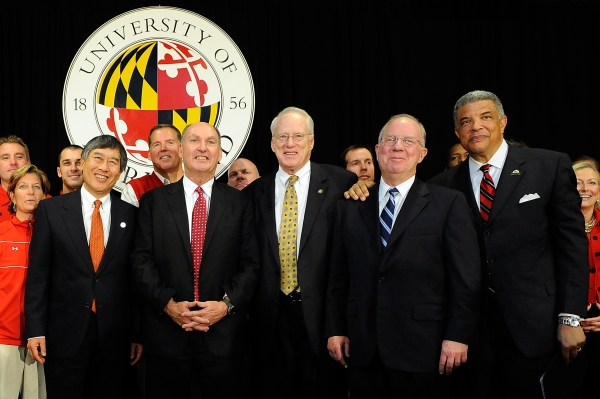
On November 20th, the University of Maryland at College Park announced that it would be leaving the ACC (not a slouch of an athletic conference by most standards) and becoming part of the Big 10 Conference.  It was a curious move for all sorts of reasons (e.g. with the exception of Pitt & Penn St., Maryland is not a geographical neighbor to any of the other member schools of the Big 10), not the least of which being the way the decision was made and announced--the Board of Trustees started and finished the process in under three weeks and some regents weren't aware of the final decision until hours before it was announced to the media.  

Not surprisingly, finances played a big role in the decision and in providing a rationale for the move, Maryland President Wallace Loh made a rather interesting statement about Maryland's future potential to use the athletic department to subsidize other parts of the university (something many would call a pipe dream).  As reported in Inside Higher Ed, Loh has publicly declared that "substantial funds" from Maryland's new revenue stream as a member of the Big 10 Conference will be used to support the educational mission of the university, specifically through financial aid for needy students.  Loh then asserted that Maryland is "doing nothing less than developing a new financial paradigm for intercollegiate athletics."

On its face, Loh's statements and ideas seem laudable.  What could be better for college athletics than an institution where the athletic program, rather than being a drain on institutional resources, puts money back into the pipeline and for needy students, no less. However, viewed another way, this is just another example of athletes--specifically, those who participate in high-profile, revenue-producing sports (which at most institutions means football and men's basketball)--whose talent is used to bring prestige and financial gain to the larger institution.  What's more, writers like William Rhoden, would argue that systems such as the one Loh is advocating for, have historical echoes to early American History when African American men were oppressed for the benefit of the more privileged class of American society.  In his book Forty Million Dollar Slaves, Rhoden provides a narrative of black athletes in the US (who, make up the majority of athletes of high-profile teams in Div. I college athletics).  He describes the evolution of professional and collegiate athletics in the US as one that led black athletes from literal plantations--where sports were used as a distraction to quell uprisings among slaves--to symbolic plantations where professional sports franchises and intercollegiate athletic departments continue to exploit black athletes' skills.

Critics of the views put forth by Rhoden and others are quick to point out that high-profile scholarship athletes receive scholarships that cover tuition, books, room, board, and virtually any other expense they might incur directly related to their enrollment in the institution.  Further, by providing opportunities to black athletes (often from urban areas and familial cultures where higher education isn't the norm) to attend college, the institution does much more than give someone a chance to play basketball, they change his life trajectory.

My purpose here isn't to argue for one position or another, just to raise some interesting questions about college athletics in general, and Wallace Loh's views in particular.  Is a free college degree and the opportunity for a better future enough "payment" for what an athlete (or team of athletes) brings in for a university?  And, how often does the four-year athletic scholarship really lead to the opportunities cited by proponents of big-time college sports?  What does it mean for one student (or group of students) to subsidize the cost of enrollment for another group of students?


Friday, October 19, 2012

Incentives & Risk-Taking in Admissions

One of the most interesting phenomena in higher education is the admissions process.  Students develop ulcers over it; parents shell out cash to hire professional admissions consultants to give their child the best shot at getting into their top-choice school, and those hearty souls who work in enrollment management stay up nights trying to figure the whole process out.  I have never worked in admissions and probably won't at any point in my career, so I realize the danger in commenting on something that I probably don't know enough about as I should.  That said, it seems that the ultimate objective of an admissions office or department is to admit those students who (a) will persist to graduation and (b) provide a good "value" for the institution in terms of the cost of providing an education to that particular student.  Consequently, the "golden egg" for a particular school is , so to speak, a highly academically qualified student who can pay the full sticker tuition price, whatever that might be.  Of course, this is an oversimplification and doesn't generalize to every type of school (e.g. an open admissions institution whose mission is to provide educational opportunity to populations that have, historically, been underrepresented in higher education.

But, for the sake of argument (and so that I have something to write about today), let's assume that the above situation holds for at least a hefty percentage of the mildly selective institutions in the U.S.  In this case,  there is an incentive for an institution to minimize risk by only admitting those students that (a) seem nearly certain to succeed or (b) are relatively likely to persist to graduation and won't cost the university too much money if they aren't retained.  Clearly, a system like this decreases the likelihood that certain students will be admitted.  And, it raises questions about these institutions' commitment to educating more than just a very narrow segment of the prospective student population.

What if, however, institutions were rewarded for taking risks in the admissions process?  What if there was some kind of incentive for an institution to admit a slightly underprepared student, provide a high-quality experience to that student, and achieve some measurable level of success with that student (e.g. graduation, job placement, etc.)?  Not only would a system like this one change the admissions game dramatically and provide more students with access to institutions where, previously, they would never have been accepted.  It would also encourage institutions to be more thoughtful about the resources and initiatives they have in place to support students that may not be as academically prepared as others.

As it stands, there really isn't much incentive at all for institutions to take risks in the admissions process (outside of situations involving student-athletes).  And, often, the institutions that are viewed as most "prestigious" are those that rather than taking risks and seeking out students to whom they can add value, admit those who are a "good investment" and who are likely to make the institution look good.


Friday, July 6, 2012

Do we really need honors programs?

Promulgating hearsay is never a great idea, but I am going to do it here at the risk of regretting it later.  In a meeting this morning, where attendees discussed the future of the BYU Honors program, it was related that the President of BYU asked a provocative question:  "Do we really need an honors program at BYU?"  I was as surprised as I can remember feeling in recent memory when the story was related.  Not because I have any real affinity to the Honors program on my campus or couldn't imagine it going away, but because I've long been asking myself that question, but feared raising it publicly because of how others might respond.

The Honors experience at my institution is, no doubt, built upon good intentions.  And, for a student who fully engages in the program, they are likely to have a tremendous undergraduate experience.  This is largely because of the requirements laid out to graduate with University Honors.  In addition to more rigorous course requirements, Honors students are engaged in the arts (and write about these experiences), participate in meaningful service, submit a portfolio demonstrating their academic achievement, and write a thesis in conjunction with a research or creative project conducted in their specific area of study.  In short, because Honors students are required to engage in activities which promote deep learning, they (in theory) learn a great deal more than they would have otherwise and have a more transformative experience.  Most Honors programs also boast of small class sizes and courses taught by the very best faculty on campus.

This all begs the question, why wouldn't a campus want an Honors program?  Aside from the frequent reports that actual experience of an Honors student is likely to be far different than what is advertised in the glossy brochure (for example, on my campus many of the honors courses are actually taught by adjunct faculty, which isn't inherently negative, but far different than what is advertised to students), I can think of at least two often overlooked reasons, as to why any campus should think twice about sponsoring an Honors Program.

The first has to do with resources.  Honors programs, because of all of the opportunities they often afford students (e.g. small courses, subsidized participation in campus arts events, research opportunities), are expensive.  But, a lot of the things we do in higher education are expensive, so this alone shouldn't be overly concerning.  The problem I see has to do with the distribution of resources among students.  On my campus just under 100 students per year graduate with University Honors.  So, not only is the BYU Honors program expensive, but it devotes a large number of resources to a very small percentage of the overall student body (the incoming class hovers somewhere around 6,000 each year).  It may be naive to think that taking the resources devoted to Honors and redistributing them across the entire student body would make a difference (and, I'm willing to admit this); however, these resources could be reallocated to one or more other programs which do have an impact on a much larger group of students.  If nothing else, spending inordinate amounts of money on 100 students a year feels wrong to me in principle.

The second and more important reason I feel the way I do has to do with the implicit message that the mere existence of an honors program sends about the rest of campus (the non-honors portion of campus), which is that everything else we do here is "average," which the larger society (the various Lake Wobegons where we each live) has really taught us to see as sub-par.  As an example, I took the following text from the website of an honors program from another institution just this afternoon.  Consider what it seems to imply about the quality of the courses and learning experiences outside of this particular honors program:

What if your classes were designed around the concept of helping you practice the habit of thinking? Of helping you develop an authentic writer's voice, so that your words have "the feel of you about them," as Irish poet Seamus Heaney once remarked? Of helping you challenge yourself to such a degree that you learn things about yourself that you didn't know existed? If these questions appeal to you, then you've come to the right place.


I can't help but chuckle at the thought of a student reading this and thinking "Do I not practice thinking in my other classes? Maybe I'm at the wrong school."  What I'm getting at here is that when a campus creates an  honors program and then boasts of the great experience it provides, it sends an implicit message to the rest of campus (students and faculty alike) that it is okay for everything else to be less than great.  In the worst cases it provides an excuse for a campus to provide an educational experience to the rest of the student body (which in the case of my campus is a large group) which is lacking in some way.

So, to be more clear, I have no problem with the things that go on in an honors program.  They are educationally purposeful and potentially transformative experiences that we would want for any and all students.  And, it is this point that is at the core of my argument--we should be providing an honors experience for all students on a campus.  Of course, on a large campus like mine that may mean scaling back the honors experience to scale it up to the entire student body.  However, we owe the very best experience possible to every one of the students on our campuses.  Why couldn't every student be required to submit a portfolio, participate in service, write a thesis, and participate in the arts (even if we couldn't make all of their classes small)?  I'm not saying that this is an easy experience to craft or provide, but the institutions that figure out how to do it (or, which already are) will be providing a service to students which the rest of us can only pretend to be offering.


Friday, February 10, 2012

The First-Year Experience movement: Are we serving or exploiting?

"I am not confident that we serve those we research well. . . .  With skepticism we should continue to question our rationale for studying the disenfranchised. . .we serve ourselves too by taking up their cause."


This is one of the more insightful things I've read in the last few months.  It comes from a book I've referenced before in a previous post.  The author is a qualitative researcher and, like many of his methodological peers, he spends a great deal of time researching populations who society views as "in need" in some way or another.  However, unlike many of his peers, he is astute (and probably humble) enough to realize that his work may not always be as helpful as he thinks.  And, it made me question the motives I have in my work and whether I am as "helpful" as I think I am.


I would consider myself to be one who is involved in what has come to be known as "the first-year experience movement."  I am an administrator in a program designed to serve first-year students, I have in the past been heavily involved in new student orientation programming on my campus, and the research I do is either focused directly on first-year issues or involves data gathered from either first-year students or the peer mentors who work with them.  I would like to think that my work serves this population in some way and that what I do each day when I come to work makes some kind of difference.  On the whole, I would like to think that my motives are pure and see myself as one who "serves" the students on my campus.  However, it would be unfair to claim that I am completely selfless in all of this.  Not only do I do this work for a salary and benefits (pretty good benefits compared to most of higher ed), but I travel to conferences 2 - 3 times a year (usually in warm places that are nice to visit anyway), am beginning to publish research on my work, and occasionally get invited to make presentations relating to my work and research.  So, the first-year experience movement has been good to me.


All of this has me wondering if, despite our good intentions and noble purposes, those of us who do this work might occasionally (and probably unintentionally) be guilty of exploiting the very population we claim to be serving.  We claim to do work that helps or serves these students as they make the transition into higher education and our scholarship is intended to advocate for these students and somehow improve the experience they have on college campuses.  But, what if the article I publish is only read by a handful of people?  And, what if after reading it, they don’t approach their work any differently than before?  Have I then used the first-year student population on our campus and elsewhere to further my career, without making any real contribution to the experiences of the real people experiencing the first year of college?  Or worse, when write a conference proposal am I ever more interested in visiting a new city and taking my wife with me, than in moving forward an argument or idea with real merit? What about that article that will be published this month? Do I really think it will add to the dialogue and help other practitioners, or did I just want a line on the vitae I'm trying to build?  


It seems like those of us purporting to serve first-year students (and this may be true for any researcher or practitioner, especially those in the social sciences) should take care to avoid becoming a player in the scholarship game where we do research, publish studies, and present at conferences, simply for the sake of those activities.  Ultimately, we probably can’t ever really know if our work or scholarship is a benefit to others and if we spend too much time worrying about any of this, we'll go crazy. All of us will at some point sincerely try to conduct a study and write a report that will “serve” someone somewhere and still miss the target.  Maybe the important thing is to be vigilant, honest, and ethical by holding ourselves to high standards and continually committing to doing the highest quality work we can. . .a helpful thing for me to remember next week when I'm enjoying warm weather and the San Antonio Riverwalk at the Annual Conference on the First-Year Experience.

Friday, February 3, 2012

What if admissions offices cooperated rather than competed?

Earlier this week, Inside Higher Ed reported on initial results of the Predictive Analytics Reporting Framework and the potential for this data to connect students to those online institutions to which they are best suited (the title of this particular section of the article is "Match.com for Higher Ed").  The senior statistician for the project, Sebastian Diaz, comments that his data set positions admissions and recruitment officials more effectively find, recruit, and enroll those students who are most likely to be successful on their campuses.  But, the article points out that this sort of academic matching service would require a level of collaboration and sharing among institutions that doesn't seem very feasible at present.

On the surface, viewing admissions as a purely competitive process makes sense.  After all, for any given institution there is a limited number of students who are, first, at all interested in enrolling at that campus and, second, who are good candidates for the experience provided, whether that is an intimate liberal arts experience, a distance ed experience, or the traditional state school experience (if there is even such a thing any longer).  What's more, for a group of institutions who share much in common, this pool of students is largely the same.  So, at some level, it is perfectly understandable that institutions compete for students.

However, this standard view of the admissions process, while acknowledging the competitive dynamic among peer institutions, fails to acknowledge two things.  First, among institutions who are very different, there is no real need to compete for students.  Second, many of the students who apply to a particular school aren't students that school is competing for and, in fact, may be better candidates for another institution.  And, despite the best efforts of campus recruiters and sometimes very expensive marketing campaigns, campuses don't always get the students they want.  So, if you and I are both in admissions on our respective campuses (and lets assume we aren't at "peer institutions" but that our campuses differ in some meaningful ways) I will, inevitably, receive applications from students that my institution doesn't want, but that yours does (and the reverse is also likely to be true--you'll receive applications from students that I want).  The trouble is that we aren't ever likely to realize this or talk to one another about it.  Instead, we'll each send our diplomatically written "thanks but no thanks" letters to our respective applicants, they will hit the trail again hoping to find a school that does want them, and we will hope that the next application we receive is from a student we do want.  Ironically, we both have pieces of information that would be helpful to each other, but we'll never share it.

So, what if an institution worked to develop collaborative partnerships with a diverse group of institutions, whose missions, enrollments, geographic locations, were different from its own .  This might be something akin to the "bridging capital" Bob Putnam describes in his book Bowling Alone, that connects us loosely to people quite different from ourselves and that facilitates access to community assets and promotes information dissemination.  If these partnerships were formalized in some way, institutions could "compete" with their peers, by collaborating with their "distant relatives.  These partnerships might give member institutions access to students they may never have found and help students by connecting them with institutions better suited for their needs, interests, goals, etc.

Typically, college athletics is not a good place to look when trying to solve broader institutional challenges; however, in the case of admissions, we might be wise to make an exception.  Like admissions, the college sports landscape is highly competitive.  Each year there are a small number of blue-chip recruits that every Div I coach wants to sign and bring to campus in the fall.  But, once you get through those 100 or so athletes for the particular sport in question, things are a lot less competitive--athletes are trying to find coaches who want them and coaches are trying to find athletes who would be a good fit for their team and campus.  What's more, the NCAA's practice of classifying athletic programs into divisions (Division I, Division II, and Division III), there is a clear and simple way of knowing if another coach's program is a "peer" or a "distant cousin."  Consequently, it isn't uncommon for a Division I coach to court a recruit and then, after realizing   that she probably won't be recruited by top Div. I programs, to make a phone call to a fellow coach at the Div. II level to let the coach know that they ought to "take a look at her."  I saw this happen fairly regularly as a student athlete.  As an example, one of my teammates at Mars Hill College in the late 90s was initially recruited by a handful of good Div. I soccer programs; however, his standardized test scores were not high enough to qualify him to compete at the Div. I level (due to NCAA regulations).  At that point, the coach from one of these programs contacted his friend who was the head coach at Mars Hill and let him know that this player may be a good fit for the program.  In this situation, both my friend and Mars Hill benefited.  We got a great player who was a four year starter and all-region player, and he got a nice scholarship and a great experience at a small liberal arts college.  The Div. I coach didn't benefit directly from this exchange; however, in coaching, reputation is everything, so he likely benefited indirectly.  The difference, then, between athletics and admissions is that when an athlete isn't a good fit for a team, there is at least some chance that the coach who has turned him down might be able to help him find another home.

While it would take some coordination and there would definitely be complexities to work out, is there any reason why this sort of sharing and collaboration among distantly related institutions couldn't happen at the level of general admissions and even be formalized in some way?  If it were to happen, it would seem to require a few things:

1)  The right kind of groupings or consortiums:  As mentioned, if everyone in the partnership is competing for the same students, it isn't likely that much sharing will take place.  So, member institutions would need to be different enough that they aren't drawing from the same applicant pools.  At the same time, if the institutions are too different, they aren't likely to have applicants that, although not a good fit for one institution, would fit somewhere else.

2)  Very clear understanding of one another's missions:  If the members of the group don't know each other well (their missions, their geographic locales, their academic offerings, etc.), they won't be positioned to make good referrals.

3)  Lots and lots of trust and good will:  As with any social contract, the success of an arrangement like this would require a collection of campuses that are willing to commit to act in the interest of one another and of the students they serve.  At the point that one member starts to hold onto students who would be better served by another member of the group, just to bump enrollments and increase tuition, things will fall apart.  Similarly, if back-room alliances between selected members result, the whole enterprise is in trouble.

I'm not overly familiar with the admissions landscape, so it's possible that this proposal has grown from a gross naivete on my part.  But, as an occasional idealist and advocate for the power of community, I want to think that it has promise (or, better yet, that it is already happening in some corner of higher ed and I don't know it).


Friday, November 18, 2011

A Ph. D. is not enough

One of the most interesting (and often painful) things I have repeatedly observed in my work over the last five years are transitions in administrative leadership at my institution and the way in which these changes are managed.  Yesterday, I was in a meeting where one of these changes was announced and, to put it mildly, it was like watching a train wreck.  In defense of the administrator delivering the news, I think he meant well and was truly doing his best to be tactful.  But, nonetheless, his social and administrative ineptitude were on display for all to see.  Consequently, an already emotionally charged situation was made worse.  This administrator is, from what I can tell, a brilliant researcher and scholar in his field (Pharmacology); however, like most faculty members, his formal training has done little to prepare him for those responsibilities which take him out of his lab.

While faculty members' responsibilities obviously vary both within and between campuses, it isn't uncommon for them to spend some percentage of their time engaged work falling outside their disciplinary area of expertise.  So, on a tour of a typical campus we would be likely to see sociologists and biologists administering departments and colleges, physicists and engineers advising students, and a lot of non-teachers teaching students.  To be fair, I know great administrators and excellent teachers with Ph. D.'s in things other than management and education; however, they are the exception.  Instead, most have wonderful intentions and want desperately to be good teachers or chairs, but struggle along because of the lack of any real preparation or training.  What's worse, there is a dangerous sub-population who suffer from a common psychological condition that condemns them to repeated faux pas and debacles like the one I saw yesterday.

The thought of an academic advisor teaching a law class or an "administrative" employee teaching teaching introductory biology are, obviously laughable, so its a bit ironic that we don't see problems in transfers in the other direction.  There has long been an assumption that an earned doctorate (in any field) qualifies an individual to do just about any other kind of work on a campus, whether it is directing an Honors college, overseeing first-year programming, or advising students about general course registration.  There may have been a time, before college campuses became the complex animal they are now, when this may have been true.  And, at a small college where resources and personnel are limited, utility infielders who teach, advise, administer, and research will always be a necessity.  However, as college campuses become increasingly complex, there will become a greater need for the professionalization of roles which, historically, have been viewed as just another part of the professorial duty.  At the very least, we cannot afford to continue to assume that a Ph. D. in Pharmacology, in and of itself, prepares anyone to navigate administrative landmines and advise students (about anything but pharmacology), and  teach (virtually anything at all).


Friday, July 1, 2011

Answering tough (and meaningful) questions: A case for narrative inquiry in educational research

In a recent posting  on his blog, John Gardner raised some intriguing questions about measuring the impact of our work with first-year students (e.g. How do we measure whether or not students love their university experience?  How do we measure transformation?).  These are, no doubt, important questions for First-Year Experience professionals to ask.   And, if we see our work as more than just boosting retention stats, they are questions that we have to grapple with.

The trouble with questions about “love,” “transformation,” or “the impact of a mentor” is that these things are tough to measure.  Granted, researchers can operationalize concepts like love and develop instruments that measure proxy indicators that the more fuzzy concepts are present (e.g. we measure “engagement” by measuring a variety of indicators including time spent working outside of class, interactions with faculty members, study w/ peers, etc.), but this approach has its problems.  Before readers’ red-flags go up, this is not a rant against quantitative research or operationalism—this type of academic work has its place and helps us to answer critical questions about student experience.  However, while p-values, standard error estimates, and confidence intervals, are sometimes seen as the coin of the realm in academia, for some questions (i.e. those mentioned by John), particularly those with deep personal relevance for us, the traditional quantitative approach can leave us feeling unfulfilled, still questioning whether or not our work has really mattered in the lives of individual students. 

 The good news is that there are other research approaches coming to be recognized as just as viable as more traditional quantitative approaches.  One that may hold particular promise for FYE researchers is narrative inquiry.  A blog post is not the place to attempt an exhaustive explanation of this discipline; rather, my intent here is to provide a brief sketch outlining the general landscape of the field.  For those wanting more depth (and much more sophisticated) than is found here, these are some good places to start:

“Stories of Experience and Narrative Inquiry,” Educational Researcher, 19(5), 1990

Narrative methods for the human sciences, Catherine Riessman, 2007

Narrative Inquiry, Jean Clandinin & Michael Connelly, 2004

Touching Eternity:  The enduring outcomes of teaching, Tom Barone, 2001


Narrative inquiry is a sub-discipline within the broader field of qualitative research.  Based on the premise that storytelling is an inherent human quality and that we live “storied lives,” narrative researchers use narrative data sources (e.g. story-telling, journals, field notes, interviews) to study how we experience the world and then make meaning of these experiences.  As an example, John’s question about love for an institution could be addressed by interviewing graduating seniors, soliciting stories from sophomore students, or analyzing  journal writing from a freshman seminar course, then identifing meaningful themes that cut across the entire set of “data.”  Ultimately, the researcher would aim to use these narrative sources to construct a “meta-narrative” that tells an overarching story related to the initial research question. 

As with any research methodology, narrative inquiry has its critics.  Common criticisms of narrative inquiry include a lack of generalizability, reliability, and validity (similar to the arguments against most qualitative approaches) and these are all fair claims.  However, as a general rule, narrative inquirers don’t view these criteria as goals of their research.  Rather, their focus is on transferability, apparency, and verisimilitude.  To narrative researchers, the narrative approach is a way of addressing personal and human dimensions of experience in ways that quantitative data cannot—they are working from a completely different set of assumptions about research.  Jean Clandinin and Michael Connelly (arguably the most well-known and well-respected narrative researchers) put it best in their paper “Stories of experience and narrative inquiry” when they said that “stories stand between the general and the particular, mediating the generic demands of science with the personal, practical, concrete demands of living” (1990). 

Lest this post be viewed as a one-sided push for a problem-free research approach, it is important to recognize narrative’s dangers and pitfalls.  Because narrative asks researchers to construct stories from qualitative data, the possibility exists for individuals to fake the data and concoct pure fiction, based on nothing but unfounded assumptions and only anecdotal data.  Additionally, narrative could be used to misrepresent experience and promote deception.  Finally, some narrative researchers (particularly when stakes are high) may present only “Hollywood stories” where, for example, students love everything about their university experience, become deep learners, and are transformed by their college experience for the rest of their lives.  But, it bears mentioning, that similar claims could be made of virtually any approach to research, even quantitative methods.

While narrative inquiry may not have the tables and statistical significance that sways some political and campus leaders, there is rhetorical power in human stories that we can relate to and that elicit similar stories from our own experiences.  What’s more, narrative inquiry is gaining traction among educational researchers, as evidenced by the recently formed Narrative Research SIG within AERA, the convening of the first ever Narrative Inquiry conference this last May, and the well-respected work of Clandinin and Connelly.  Most importantly, narrative offers an approach for answering those questions, like John has posed, that are deeply meaningful to us personally, and whose answers we use to measure the impact of our careers.