Friday, March 22, 2013

On Intentionality: An argument against hoping good things will happen

"Unless the students' experience of classes is connected, it is trivialized. Any course that isn't part of a larger journey is a dead end."

This comes from one of the best books on higher education that I have read in the last decade, The Learning Paradigm College, by John Tagg. It represents what I believe to be the biggest failing of higher education, which is our consistent inability to provide a cohesive, holistic experience that, taken together, actually means something for students. If you haven't read Tagg's book, you should.  And, if you think you don't have time or that the $9.69 it will cost you to buy it used on Amazon is too steep a price, at least read the seminal article upon which the book is based.

Given my frustrations with the problem of fragmentation that pervades higher education, I was ecstatic to hear about my own institutions efforts to provide our students with an alternative approach to their general education.  As I listened to our Associate Dean for General Education describe this new "mosaic" approach to general education, I had to pinch myself a few times. What she was describing seemed nearly identical to what I had dreamed about for some time. General education courses would be grouped thematically. Students would be invited to select a mosaic that provided a series of linked courses, all exploring a larger theme or issue. There were options that aligned with particular courses of study, as well as more general mosaics that could complement nearly any degree program. And, most importantly, it seemed aimed at providing students with an integrated experience that could connect with their interests and future goals. But, the longer I listened, the more I started hearing what became a very troubling phrase: "We hope. . . ."

Let me be clear, there are lots of things for which I hope. I hope my March Madness bracket doesn't get any worse than it did last night. I hope it will stop snowing outside my office so I can walk across campus to the Education in Zion Gallery. I hope my daughters will fall asleep early tonight, so I can spend quiet time with my wife. And, I hope that both of those daughters will become more and more excited about learning as they grow and eventually want a college education.  Hope is great.  But, only if it moves someone to action and becomes an incentive for making intentional decisions that increase the likelihood that the hope will be fulfilled. Without intentionality and action, hope is empty.  What's more, empty hope inevitably leads to the discouragement and frustration that come with unfulfilled hopes. And, as I sat listening to the presentation on BYU's new general education mosaics, I saw us headed down that path.

Theoretically, the notion of mosaics seems sound. After all, if the problem is that students aren't connecting their learning across courses, the solution is to connect the courses for them, right? If we map out those connections and then tell students to take, for example, "Environmental Biology," "Introduction to Human Geography," "Theories of Human Freedom," and "Current Social Problems," they will have completed the "Human Dignity" mosaic and have had a connected experience. Right?  Well, what I found out during part two of the meeting was that we hope this happens. While the mosaic initiative sounded great on the surface, it turns out the proposal is to do nothing more than provide students with a webpage that shows how various courses are connected around loose themes. No culminating or integrative academic experience. No collaboration among faculty members. No invitations to students to demonstrate that they have had the type of integrative experience we hope for.  The moment in the meeting that was, simultaneously, laughable and unbearingly frustrating was when the presenter was asked how many students she thought might take advantage of this opportunity (My guess is next to none because central administration has, in an incredibly curious move, barred the sending of any formal communication to students about this new initiative. Instead, the hope is that students will find their way to the obscure website I linked to above, be fortunate enough to take the initiative to meet with an academic advisor who happens to be aware of and endorse the mosaics, or be told about mosaics by one of the 13 students who meet the previous two criteria).  The response to the question: "We're really not sure how many students will take this route.  But, we hope that even for those who don't, just thinking about the possibility of making these connections will make GE more meaningful for them." Cue unicorns, money descending from the sky, and raucous laughter at our foolishness.

This assumption that grouping courses thematically and attaching a hip name to these categories will fundamentally change the experience of students flows from what Tagg has described as the Instruction Paradigm.  From this perspective, the business of colleges is to offer instruction and "learning" is then operationally defined as teaching classes. You see this at the core of my campus's mosaics: "If we offer the right courses (hopefully the same courses, so it doesn't disrupt things too much) and then point out that they are "connected," students will the make the connections and have an integrative experience.  Lots of empty hope, without any intentionality or strategic thought about the process of learning.

In contrast, Tagg's Learning Paradigm defines a "curriculum" as being about what students learn, not what teachers teach or what courses are offered:
The curriculum should be the institution's systematic plan for what and how students learn (emphasis added). The guiding principle in restructuring curriculum should be that the whole is more important than the parts. Individual courses are of trivial importance. What matters in terms of the students' whole experience is how courses--or other learning experiences--fit together. Colleges should seek to create a curriculum that leads somewhere rather than spinning in an infinite variety of nonintersecting circles. A curriculum should not be a list of classes; it should be a description of learning outcomes. (The Learning Paradigm College, Tagg, p. 326).
The problem with BYU's mosaics is that they are still built around individual courses.  We're still operating from the Instructional Paradigm. Until there is a fundamental change in perspective away from trying to recycle worn out tiles (i.e. courses) to cobble together a poorly looking mosaic (general education), we'll still be providing a fragmented experience for students. Instead, what BYU (and a lot of other institutions) needs is to stop thinking about courses and start thinking about learning. There are at least two fatal flaws in BYU's current mosaic program. First, there has been no attempt to show students where we want them to end up, which is to say that we haven't developed any clear and understandable descriptions of the outcomes for the mosaics (rubrics, video recorded interviews with students who have achieved these aims, and other multi-media descriptions of this type of learning would be a great start). Second, we haven't designed any learning experiences or environmental features that encourage integration across the courses that make up a mosaic (e.g. capstone experiences, assignments or projects that span across courses, faculty collaborations, reflective or integrative writing assignments).

To hope is not enough. Institutions have a responsibility to design and structure both experiences and environments that move beyond hope and into the realm of intentionality and action.


Friday, March 15, 2013

Tears, disappointment, and feelings of success: Revisiting the power of reflection

A significant portion of my time each week is spent in conversations with undergraduate peer mentors who work in the Freshman Mentoring program at BYU. I've found that one of the best things I can do in these conversations is to ask peer mentors to tell me stories about their mentoring work. For me, this is a beneficial exercise because hearing these stories gives me remarkably raw and authentic insight into the experiences of the mentors I'm supposed to support and develop.  Some are stories of success (e.g. a student who finally agrees to visit the counseling center for help in dealing with a mental health challenge); some are stories of failure (e.g. I met with the student three times before the exam and he still failed).  But, the most interesting stories I hear are those that are a bit of both.  Earlier this week I heard one of these "hybrid" stories. And, as I listened, I was reminded of how powerful reflection on experience can be in driving learning and facilitating personal transformation.

Topher is everything a person like me would want in a peer mentor.  He is a great student, not just because he is successful in terms of things like GPA, but because he understands learning in the deepest sense.  He reads, writes papers, and prepares for exams because he enjoys learning and knows that he's preparing himself to be more useful as a citizen, an employee, and a human being. He    is a southerner and endears others to him with his easygoing nature, big North Carolina Smile, and social versatility (in a single conversation he can talk intelligently about philosophy, transtition to Chinese culture, and then finish with his thoughts on why the Duke Blue Devils are the most overrated team in the upcoming NCAA tournament. When you meet him, you don't have any reason to believe he wouldn't be successful in just about anything he does. What's more, he fully expects himself to be successful. This isn't to say he's arrogant--it's just that a lifetime of experience has taught him that if he works hard, he'll achieve.

Last fall when he first began working for us, that narrative of traditional success continued. His students loved him, they lined up out the door to meet with him, and he felt incredibly useful and successful.  After all, he was helping lots of students and they appreciated him for it.  However, when he returned from Christmas break and inherited a new group of second semester freshmen  to mentor, things were a lot different.

It's important, at this point, to understand the nature of the work of peer mentors at BYU. During fall semester, they provide mentoring support to a group of students who have just arrived on our campus.  They don't know where the library is, they have never lived away from home, and they are generally fairly receptive to help from someone who has been down the college road before. What's more, my experience has been that new students have a way of imprinting upon their peer mentor(s) because they are one of the first people they meet when they come to campus for New Student Orientation. So, during this first semester, peer mentors are positioned to be both needed and wanted by the students to whom they have been assigned.

Winter semester is different.  Because mentor assignment is determined by course registration, mentors inherit a group of completely new students and students are handed off to a new mentor, with whom they have no relationship. And, there is no imprinting period to facilitate the development of this new relationship.  On top of that, students have been at the institution for a semester and (for the most part) have been successful in passing their classes. This all means a rough slog for an invested, interested peer mentor like Topher who ideally wants to build a relationship with all of his students.

The story of Topher's mentoring so far this semester has been sporadic meetings with somewhat apathetic students who come to him mostly because they feel guilty if they don't respond to the guy who has been emailing them since January. And, a good portion of the time, a student will make an appointment, but then never show up.

This all sets the backdrop for the story Topher told me last Tuesday in our meeting. He had finally made a breakthrough with a student who has been struggling all semester.  The student is failing most of his classes, rejecting the help offered by professors, teaching assistants, and others, and up until recently, had never responded to Topher's emails. But, late last week, he came out of the woodwork and scheduled a meeting.  So, naturally, when I met with Topher earlier this week, I was expecting to hear a story about how successful he had felt.  I did hear a story, and it was about success, but it didn't really fit the typical "script" of peer mentor success (or at least the script Topher had held about what it means to be successful up to this point).  In Topher's own words:

"Today I had a meeting with Brad [Topher's student supervisor] and we talked about my meeting with Caitlin. She came to our meeting peppy but when we started talking she broke down in tears about her feelings of self-disappointment and failure. She hasn’t been performing up to her standard in organic chemistry and it’s had a negative emotional impact on her. Brad turned that into a discussion about the nature of success and how it should be measured. Since I’ve encountered a great deal of difficulty in setting up student meetings and have any form of consistency in my meetings with students, like Caitlin I haven’t felt like I’ve earned an A in mentoring this semester. I feel that my impact has been minimal or at best superficial. But I want the depth, and I want to really be an agent for change or growth in the lives of these students. That’s the attitude that I’ve brought with me to my meetings, and it’s the attitude that I took with me into my preparation for my meeting with George. I spent an hour  and a half extensively planning a reflective meeting to help adjust his perception of American Heritage [a challenging general education course required of all BYU students]. From the last meeting we had he disclosed that he didn’t care much for the class and didn’t see much of a point in it. What I saw in him as we talked was a deeper apathy about his BYU experience in general, so that’s where I was going to begin, but he cancelled; and I felt especially disappointed. I really wanted that meeting to happen, not because I needed employment or because it was obligatory for me to insert myself into the life of this student, but because I really wanted to. He didn’t show, and I felt a disappointment I haven’t felt since my mission. I realized in the moment that I felt such significant disappointment that I was being successful as a mentor; that I was doing things right."

As much as I'd like to take credit for facilitating this shift in Topher's thinking about what it means to mentor and what it means to be successful, it didn't have anything to do with me.  In fact, Topher had "told" this story before he ever sat down in my office. His story (as shared above) was actually a reflection he wrote on the day George stood him up. At the moment he was feeling discouraged at not being able to help, one of his first thoughts was "I need to reflect on this." Somehow, he knew there was a lesson embedded in this experience, but that he wouldn't discover unless he started to write.  So, he pulled out his laptop and typed out this story.

For peer mentors (and, I would argue, any learner), telling these sorts of stories isn't just therapeutic. It is a reflective tool that positions them to make meaning from experience and move toward new understanding.  In Taylor's story, we see how his understanding of what it means to be a mentor has shifted from "meeting w/ students" to "being prepared to be a resource who can support student success." Relatedly, he comes to redefine success not as holding meetings, but in genuinely caring about the success of his students and doing all he can to support them. And, this is not insignificant learning for someone in his role. It represents a fundamental shift in his frame of reference towards mentoring and will shape how he approaches and evaluates his work in the future. In this way, it seems closely aligned with what Jack Mezirow has described as transformative learning that is personal, irreversible, and integrative.

This is the type of learning that is possible when we engage learners in meaningful reflection on experience.  Reflection invites learners into a space where they can inquire into their assumptions, derive learning from experience, and articulate new understanding.  Topher wasn't just telling a story or simply putting into writing something he already knew.  He learned as he wrote.  That's the power of reflection.

Friday, March 8, 2013

Why are we so bad at spotting "talent?" And, what does it mean for colleges?

If I were to show you the picture at right (minus the text at the bottom), what would be your guess at the occupation of this man?  Accountant? Used car salesman? Computer engineer? Nope.

This is +Tom Brady, three-time +Super Bowl Champion, two-time Super Bowl MVP, and eight-time Pro Bowl Quarterback. On paper, in person, and on film, Brady would have been a bust for any team looking for a quality quarterback (here's 30 s. of video evidence further reinforcing how utterly unimpressive Brady was as an NFL hopeful). But, +New England Patriots Head Coach +Bill Belichick can do something most of us can't. He can spot talent.

One of my least favorite parts of my job is interviewing and hiring undergraduate students to be peer mentors in the department where I work. Part of this dislike stems from hours of conversations built around the same eight or ten interview questions, which typically yield the same mundane responses from applicants. But, I've also wondered (out loud at times, which gets me in trouble) whether we might have just as much luck throwing the applicants names in a hat, drawing out 50 names, and hiring them. In short, we often care too much about things that don't matter (high GPA, impressive essays, and well-articulated responses to our questions). And, every year we have a "Tom Brady" who we somewhat grudgingly hired, but who then turns out to be one of our best finds.

The same thing happens in various other parts of the academy, but most notably in admissions. This is particularly true when campuses heavily weight more "visible" factors such as standardized test scores, long lists of service and leadership experiences, and HS GPA (though it's a better predictor than standardized test scores).  We're overly impressed with "achievement" and "performance," while undervaluing more subtle and less visible characteristics like resilience, grit, and the ability to receive and use feedback.  This is what Belichick looked for and noticed in Brady and that allowed him to feel comfortable using a sixth round draft pick on someone no one else really wanted. But, Belichick only learned this because he focused on the right piece of data.

Belichick's method is pretty simple, when the Pats find a player at the NFL Combine that they are slightly interested in, they schedule an interview (which is pretty standard).  But, what he does next is where the genius lies.  Belichick has his staff find footage of one of the player's worst performances from their most recent season.  He turns off the lights, plays the clip, and then asks the player "What happened?"  Then, he listens for how the player responds to and explains poor performance.  The conversation that follows helps him identify whether or not the player has the right mindset to play for him in New England. He is only interested in players who want to get better and have the qualities that make that improvement possible.

My colleagues and I need to be more like Belichick and find ways to use our application and interview process to understand the less visible (but more important) qualities of our peer mentor candidates. And, institutions should move, more and more, towards models that allow them to gain insight into the kinds of qualities that Stanford University has come to value and celebrate in recent years and that have been researched by Angela Duckworth and her colleagues. This isn't to say that Tom Brady's speed didn't matter at all, a peer mentor applicant's well-written essays shouldn't be considered, or that a HS GPA shouldn't be considered when deciding whether or not to admit a prospective student. Rather, we should be looking beyond these attributes and find ways to understand whether or not applicants have the qualities that will allow them to thrive and develop once they get into the system and benefit from the training, coaching, and resources provided by the institution or organization. When we do, we'll start to find a lot more Tom Bradys and avoid bringing in any more Ryan Leafs.


Friday, January 18, 2013

The best kind of colleague

One of my favorite collegial pairs, partly because I'm a descendant
 of the actual Butch Cassidy (aka Robert Leroy Parker).
“A good definition is almost impossible, but you know one when you see one. The connection is almost immediate.You know it's going to be a good day because you will be seeing that colleague.”                                                                         

-Anonymous


This morning, in her "A Kinder Campus" column that regularly runs in Inside Higher Ed+Maria Shine Stewart posed the question "What makes a good colleague?" The column is thoughtful, well-written, and inspiring--well worth the five minutes or so it took me to read it.  And, it invited me to reflect on what kind of colleague I am.  This assertion, from one of the colleagues Stewart interviewed for the piece, was particularly thought-provoking for me: a colleague is someone who listens and helps a peer when it would be easier just to focus on his or her own responsibilities." Far too often, I'm guilty of becoming wrapped up in my own to-do list or project and forgetting about or even consciously avoiding interactions with others so that I can be more "productive." My department (and my own soul) will be kinder when I finally kick that habit that has crept into my work over the last few years (I rationalize by blaming it on becoming absorbed in my doctoral study, which is probably a factor, but clearly not the only culprit).

In reflecting on Stewart's column and her description of collegial relationships, I recalled a Christmas gift I received over the break that initially only struck me as incredibly thoughtful, but which upon further thought seems to represent the best kind of colleague I could ask for.

My friend +Drake Allsop ordered me a copy of Dan Pink's newly released book (To Sell is Human) and had it delivered four days before it was even available in bookstores.  For someone like me who loves to read, loves social science-esque books, and is a fan of Dan Pink, it was a pretty cool gift to receive.  In that respect, it was the type of gift I might have received from any of a number of friends and family who know those things about me.  But, because of my relationship with Drake, the experiences we had when we worked together at BYU, and some subtle things he did in the giving of the gift, it was a uniquely collegial.  Let me explain.

To begin with, Drake was a student who worked for me in BYU's +BYU Office of First-Year Experience.  Consequently, our relationship should have been dictated by the traditional employer-employee norms, with me as the authoritative supervisor and him as the student who followed directions and did his work (a far cry from collegiality).  However, Drake very quickly became much more of a colleague because he engaged with me in ways that few other students have.  He read what I read, initiated enlightening conversations with me about academic ideas, challenged me when my thinking was off or he saw that I could make some kind of improvement (I'll never forget the day he told me my presentation slides for an upcoming conference were pretty boring--it's true they were and the revised slides were much better), and became a partner with me in my learning.  We also laughed raucously and irreverently almost every day we worked together, which I've found goes a long way towards building a relationship.  

I see a lot of the best parts of my relationships with good colleagues represented in Drake's gift.


1.  It recognized, acknowledged, and validated my intellectual interests.  Drake knows I like Pink and knows what kinds of ideas I enjoy being exposed to.

2.  It invited me to grow and expand my mind.  Drake knows I'm busy and that I'm probably not reading as much as I should now that the new semester has started.  Sending me the book was a subtle reminder to me that I need to continue to expose myself to new ideas, even when I don't think I have time or energy.

3. It challenged me.  A little context is helpful here.  Drake graduated from BYUs Marriott School of Management, and while he is definitely not your typical business student (case in point, he is now an elementary school teacher), we had and probably continue to have some philosophical differences about various issues.  He probably also knows that I shun commercialism, sales, and most profit-motivated ventures.  So, receiving a book that, on its cover (literally), is all about selling myself is a bit of a challenge to my way of thinking.  I appreciate that and it is something that the best colleagues do for their friends.

4. It was an invitation to engage in a conversation with Drake about important ideas.  In the text message Drake sent me a few days after I had received the book he mentioned that he is reading the book too, and that he looks forward to talking with me about it.  While that's the kind of thing acquaintances say to each other (kind of the grown-up or academic version of "hey, we should hang out sometime"), but don't really mean, Drake is sincere.  I fully expect to have that conversation with him when I finish the book.

I'm grateful for both a new book, as well as good colleagues.  They make my work, my learning, and my life (which are all terribly intertwined these days) much more meaningful.

Friday, November 30, 2012

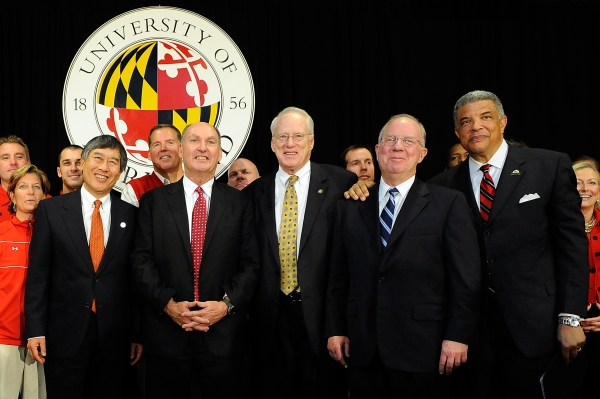
Exploitation of College Athletes Revisited: Maryland's move to the Big 10

On November 20th, the University of Maryland at College Park announced that it would be leaving the ACC (not a slouch of an athletic conference by most standards) and becoming part of the Big 10 Conference.  It was a curious move for all sorts of reasons (e.g. with the exception of Pitt & Penn St., Maryland is not a geographical neighbor to any of the other member schools of the Big 10), not the least of which being the way the decision was made and announced--the Board of Trustees started and finished the process in under three weeks and some regents weren't aware of the final decision until hours before it was announced to the media.  

Not surprisingly, finances played a big role in the decision and in providing a rationale for the move, Maryland President Wallace Loh made a rather interesting statement about Maryland's future potential to use the athletic department to subsidize other parts of the university (something many would call a pipe dream).  As reported in Inside Higher Ed, Loh has publicly declared that "substantial funds" from Maryland's new revenue stream as a member of the Big 10 Conference will be used to support the educational mission of the university, specifically through financial aid for needy students.  Loh then asserted that Maryland is "doing nothing less than developing a new financial paradigm for intercollegiate athletics."

On its face, Loh's statements and ideas seem laudable.  What could be better for college athletics than an institution where the athletic program, rather than being a drain on institutional resources, puts money back into the pipeline and for needy students, no less. However, viewed another way, this is just another example of athletes--specifically, those who participate in high-profile, revenue-producing sports (which at most institutions means football and men's basketball)--whose talent is used to bring prestige and financial gain to the larger institution.  What's more, writers like William Rhoden, would argue that systems such as the one Loh is advocating for, have historical echoes to early American History when African American men were oppressed for the benefit of the more privileged class of American society.  In his book Forty Million Dollar Slaves, Rhoden provides a narrative of black athletes in the US (who, make up the majority of athletes of high-profile teams in Div. I college athletics).  He describes the evolution of professional and collegiate athletics in the US as one that led black athletes from literal plantations--where sports were used as a distraction to quell uprisings among slaves--to symbolic plantations where professional sports franchises and intercollegiate athletic departments continue to exploit black athletes' skills.

Critics of the views put forth by Rhoden and others are quick to point out that high-profile scholarship athletes receive scholarships that cover tuition, books, room, board, and virtually any other expense they might incur directly related to their enrollment in the institution.  Further, by providing opportunities to black athletes (often from urban areas and familial cultures where higher education isn't the norm) to attend college, the institution does much more than give someone a chance to play basketball, they change his life trajectory.

My purpose here isn't to argue for one position or another, just to raise some interesting questions about college athletics in general, and Wallace Loh's views in particular.  Is a free college degree and the opportunity for a better future enough "payment" for what an athlete (or team of athletes) brings in for a university?  And, how often does the four-year athletic scholarship really lead to the opportunities cited by proponents of big-time college sports?  What does it mean for one student (or group of students) to subsidize the cost of enrollment for another group of students?


Friday, November 16, 2012

Sending a message very different than the one we intend

Because I am a graduate student at the institution where I work, I receive an email each semester I am enrolled in courses (which at this point is every semester, because the sooner I finish my dissertation the sooner my wife can stop being an academic widow) inviting me to submit "student ratings" for the courses in which I am enrolled and the instructors who teach these courses.  Although I doubt the utility and value of the exercise, my sense of duty compels me to try to submit thoughtful ratings each semester.

I've completed this process at least twice a year for nearly the last 10 years; however, it wasn't until this morning when I was submitting my ratings for the current semester that I noticed this statement on the "Student Ratings Homepage:"

A message to students from President Samuelson

Student evaluations of BYU faculty and courses are extremely important.
  • Faculty are expected to consult them to improve their courses and teaching methods.
  • Department chairs are expected to review them annually with faculty to assess teaching effectiveness.
  • University committees consider them carefully as part of faculty reviews to determine who is retained and promoted.

Without your responsible input, we cannot effectively assess and improve teaching performance and student learning.  Please be honest, fair, and constructive as you complete your evaluations.
Your evaluations matter.
Thank you,
President Samuelson 
  
At first glance, posting a message like this on a webpage where students initiate the rating process makes sense.  An institution wants students to submit ratings, so someone on a committee suggests that a formal statement of support be made and displayed in a public place.  It is a very simple thing, doesn't require much time of anyone, and we can all feel good about being "supportive" of a particular initiative (in this case, student ratings).

However, one could offer a very different interpretation of the one above, which is the interpretation I made when I noticed the statement this morning.  A committee somewhere in the institution was charged with finding a way to increase student participation in the rating process, was told "these evaluations matter," doubted the truthfulness of that statement (the person who said it probably did too), a secretary somewhere drafted a statement, it was approved by the university president, and then "publicly" displayed but in a place and in a fashion that made it discrete enough that it wouldn't cause any problems or change any aspect of the cultural norms that prevail on campus with regard to teaching and learning (e.g. faculty can teach a course any way they want so long as they don't give inaccurate information, act abusively toward students, or teach anything that would make the Board of Trustees anxious).  The net result of the hypothetical process I've described above is that a very different message than the one originally intended becomes encoded in the way the explicit message (Evaluation Matters) is conveyed.  While the text of the message clearly states that the institution cares about student ratings, the tone of the message (e.g. its formality), the way it is displayed (on a webpage that 1/2 the student body visits and that probably 3% read), and the absence of this message in any other venue outside of the email sent to students (reminding them that their ratings are "important to the University and used in many ways"), convey a counter-message that student ratings are a necessary part of the institutional landscape but one that few of us really care about.

Again, the issue here isn't whether or not institutions should care about student ratings.  Rather, institutions should be careful to consider all of the components of a message, not merely text, when attempting to convey a message to students.  Factors such as tone, placement, repetition, consistency, and alignment with institutional practices will, ultimately, be much more powerful communicators than static text on a page or in the body of an email and communicate a hidden curriculum to students that can be quite impactful.  And, when these factors have the potential to communicate a message very different from the one intended, institutions run the risk of coming across as insincere, bureaucratic, and naive.

For a great example of holistic messaging that really conveys the message an institution wants students to hear and embrace, see Westminster College's message about e-Portfolios from former president, Michael Bassis.  Contrast the amount of time, energy, and thoughtfulness that went into this messaging with the message I referenced above from my own institution.  Could a student doubt that Westminster College values e-portfolios after watching a taped message from the President and then reading through an e-portfolio that he created himself?  Very different from the message that would have been conveyed had the college opted for a static text-based message on an obscure webpage.


Friday, November 9, 2012

Another exploitation of athletes . . . this time in the NFL

I've written before on this blog about the problem of exploitation among athletes in high-profile sports (i.e. football & men's basketball).  Thanks to Allison Morris from Accountingdegree.com for sharing this graphic that explores a problem associated with the NFL, namely the high rate at which retired players experience financial duress (3 in 4 are in financial trouble within two years of retirement).  Clearly, the league cannot control the decisions of its players, but this work raises interesting questions about what role major sports leagues should play in preparing players for their post-athletic futures.  How much responsibility does an employer like the NFL bear to prevent these kinds of problems?


Please Include Attribution to AccountingDegree.com With This Graphic Benched and Broke Infographic