Showing posts with label politics. Show all posts

Friday, August 8, 2014

Three BYU images that made me cringe (and laugh) this week

Image #1:  The Presidential Inauguration Invitation (Are there storms ahead for BYU?)

On September 9th, Kevin Worthen will be inaugurated as the 13th president of BYU.  I know this because I received a formal invitation to the inauguration activities in my campus mail box last week.  Like most of the communications that come from the President's Office at BYU, the invitation was highly formal and signaled the formality and tradition associated with the event.  Like most formal invitations, it was also highly impersonal and forgettable, except for the curious image that appeared on the front cover (see below):


I didn't notice it at first, but the tone of the cover raises some funny (if not alarming) questions about the next few years at BYU:  Is there a storm brewing?  Are dark clouds ahead? I wasn't worried about the new President, but should I be?

It's a nice enough image of an iconic aspect of BYU, but it's a strange image to select to announce this particular event.  Dark, ominous clouds aren't really what I would use to represent an event that most would associate with new beginnings, renewal, and optimism.  I'm actually looking forward to President Worthen's administration and have no reason not to be optimistic, but optimism isn't what I feel when I look at this invitation.


Image #2:  The 2014 BYU Football T-Shirts

After I read this story, I started to wonder if BYU Athletics and the President's Office might have been using the same marketing intern this summer.  In what I see as delicious irony, it was revealed this week that BYU Football's anticipated 2014 slogan ("Rise as One") has already been used by. . .wait for it. . .Budweiser of all corporations (you couldn't make this stuff up), not to mention by Nike the year before .  Not really the association the athletic department was going for.  Apparently, no one had the 12 seconds it would have taken to do a google search of the slogan before printing thousands of t-shirts.


Image #3:  "Please tell me he's not one of our alumni" 
People tend to turn into idiots when they have a microphone, news camera, or reporter in front of them, as demonstrated very well by Cliven Bundy over the last few months.  Not only are Bundy's views on government extremist and skewed, it appears that he is also racist and somewhat deluded.

I cringe anytime I see any news story associated with he or his family, but especially when I saw this accompanying photo this week (look at the t-shirt his son has on).

I don't know if Cliven Lance Bundy (the son) ever attended BYU, but just him wearing the shirt in front of reporters is probably enough to make the Alumni Association pretty nervous.


So, to the President's Office, BYU Athletics, and the Bundy clan--thanks for making me laugh this week!  Here's to hoping the press for BYU is a little less embarrassing next week.


Friday, March 14, 2014

We're not all Paul Ryan or Aaron Osmond: An argument for supporting all parents and all children

Last Thursday, in his remarks at the Conservative Political Action Conference, Republican Senator +Paul Ryan (Wisconsin) took aim at free school lunch programs, using them as an example of the way in which the left offers "a full stomach, and an empty soul."  His remarks seem to imply that children who eat school lunches (whether they're subsidized or not) have parents who love them a little less than their best friend who brings her sandwich and apple in a nice brown paper sack (In a deliciously ironic move, he finished the speech by relating a story that was originally told by Laura Schroff, who I heard speak two weeks ago and who is actually an advocate for the programs Ryan seems to despise).

Ryan's remarks fit the pattern I've observed a number of times, from various politicians, over the last year or so.  The narrative goes something like this:    "The [opposition party] is morally wrong for providing free [fill in the blank].  Parents who take advantage of this [fill in the blank with federally subsidized program of your choice] are bad parents.  Good parents do [fill in the blank with what your "good parents" did to make you into the moral role model you are today].

A supporting case (or two) -- last summer, Utah State Senator +Aaron Osmond proposed that mandatory school attendance be abolished because it encourages parents to shirk their responsibility to educate their children (a view I've critiqued here).  He softened his stance somewhat later in 2013 and offered up a modified proposal that would require parents to opt-in to the public education system.  In Osmond's modified plan, those parents who avail themselves of public education's services would also be required to enter into a "Public Education Parent Participation Contract," that among other things would require them to attend all parent-teacher conferences, ensure all homework is completed, and cover the costs of any remediation received by their child.

Underlying arguments like those made by Osmond and Ryan seems to be the belief that every parent of every child is equally capable of providing the very same support.  Ryan believes every parent can and should make his child's lunch in the mornings.  Similarly, Osmond seems to believe that parents come in a two discreet types:  (a) those skilled and competent enough to educate their own children or (b) financially secure enough to cover the costs of their children's "remediation" (not sure what that means, but apparently Osmond has a nice tight definition for it that will avoid all controversy ).

Osmond, Ryan, and others making these kinds of arguments seem to have forgotten that parents come in a wide variety of "flavors."  While the brown bag lunch crusaders and laissez faire education advocates would like to believe that every parent has an equal (and, it seems, inexhaustible) supply of educational acumen, time, and money, the reality is that today's parents look a lot different than those that raised Osmond and Ryan.  There are parents who, despite their desire to be as helpful to their children as possible, don't have the intellectual, social, and financial capital as do others in their communities.

Osmond's proposal is presented as a way of "liberating" parents from the mandates of an oppressive government, however, this liberation only extends to a certain class of parent.  Osmond seems to have forgotten the parent who works 2 - 3 jobs, speaks limited English, or who can't afford to pay for remediation.  Ultimately, for a growing segment of the population, these plans masquerade as virtuous ways of supporting and liberating families, when in reality they are veiled forms of oppression for those without the privileges enjoyed by the naive lawmakers making the proposals.  Utah Senator Luz Robles, in responding to Osmond's original plan for ending mandatory education, said it best:

Not everyone might have a highly educated, Ph.D. mom or dad, what might happen to that child [who does not]?"

If Osmond, Ryan, and others are really interested in supporting parents, they can make good by considering how educational policy and legislation might be crafted to support all parents.  In a recent post on his excellent blog, my good friend +Greg Williams argues that any comprehensive attempt to improve educational systems has to acknowledge the critical role that parents play in their child's education.  He concludes his post with this provocative question:  "Why aren't we having more discussion about helping parents be great parents (emphasis is mine)?"

It's a tremendously important question and one I would posit to those who only seem interested in penalizing those parents who, despite their best efforts, can't support their children by offering home school, packing a brown-sack lunch, or doing the things Ryan and Osmond would have us believe are the hallmarks of a "good" parent.


Friday, February 28, 2014

Is Higher Education Rehabilitative? (Read: Should inmates receive a college education?)

This morning, Inside Higher Ed reported on New York Governor +Andrew Cuomo's plan to provide the option of a college education to inmates in about 10 of New York's state prisons.  Not surprisingly, it's become a hot topic.  Opponents of the plan are raising questions about the fairness of providing a free college education to "crooks," while New York's law-abiding citizens are struggling to find ways to finance higher education.  And, in one of the more bone-headed things I've read recently, State Assemblyman +Jim Tedisco claimed that the program would just produce "smarter criminals."  Advocates for Cuomo's proposal argue that investing in higher education for inmates will reduce costs in the long run by lowering recidivism rates (a claim backed up by loads of research, as well as the state of Indiana's long-running case study).

At the core of this particular issue are two questions that academia has grappled with for decades.  First, is the question of whether or not a college education is transformative (or, in this case, rehabilitative).  The assumption made by Cuomo and the backers of his proposal is that the college experience, whether that's delivered in a traditional university setting or behind bars, changes learners in fundamental ways.  Not only do they acquire new knowledge and skill, but they come to see and interact with the world in new (and, we assume, more productive) ways.

This belief in the transformative nature of education is at the foundation of the second question embedded in the current debate, which is whether a society benefits when its individual citizens are educated.  For the most part, the United States and virtually every other democratic society have, to one degree or another, agreed that an educated citizenry is a better citizenry.  So, we do things like subsidize the entire cost of public education for young children, and a percentage of the cost for those pursuing higher education at particular institutions (hence, the State College).

In sum, the vast majority of Americans believe at some level that higher education is both transformative and democratically beneficial.  So, it's a bit ironic that some of those same folks are now questioning a proposal based on those very assumptions.  While the current economic state of higher education funding, and the student debt crisis, make the thought of paying for an inmates college education a bit uncomfortable, my argument is that it is clearly in line with the underlying purposes of our correctional system.  By definition, prisons are meant to "correct" and rehabilitate.  And, experience has clearly demonstrated that education is one of the best ways for this to happen.

The reality is that the majority of inmates will not choose to take advantage of a college education if it is provided, so it's a fairly safe assumption that those who do participate will be relatively engaged and committed (which is critical if the experience is to have the transformative effect we hope for).  Consequently, it's inaccurate for anyone to assume that "every crook" will get to go to college for free.  What's more, it may not be unreasonable to expect those who benefit from the program to re-pay a portion of their educational costs.  This would add another administrative layer to the program, because it would require someone to manage and enforce re-payments, but it may not be a bad approach.

For any New Yorker who really believes

(a) Education is a shared good
(b) Education makes better citizens, and
(c) Prisons are meant to rehabilitate,

I don't know how they can simultaneously oppose Cuomo's plan on philosophical grounds.  The challenge will be for Cuomo and the SUNY system to make it work from a practical standpoint.

Friday, November 22, 2013

The John Swallow Resignation: Mistakes were made (but not by me)

This morning, the Salt Lake Tribune reported on what I think is one of the most interesting types of social phenomena we observe in our modern society--the resignation of a high-ranking official in the wake of accusations of misconduct.  The state of Utah breathed a sigh of collective relief this morning at the news that State Attorney General, John Swallow, is resigning from office after only 10 months on the job.


Regardless of where you sit politically or feel about Swallow personally, the breadth and quantity of the accusations levied against him make it difficult not to question his ethics.  There were claims of facilitating bribes, promises of preferential treatment to various individuals and businesses, questions of extortion, and issues relating to the receipt of improper gifts.  And, there was also talk of possible campaign violations in his most recent election.

In the spirit of full disclosure, I lean democrat and thought Swallow was a bit shady long before he was elected (indeed, the SL Tribune's endorsement of his challenger looks pretty prescient at this point).  But, those biases aside, 88% of the rest of our heavily conservative state was less than pleased with him as evidenced by his most recent approval rating, so it's hard to argue that this has all been driven purely by party politics.  Additionally, members of his own party (including the Governor) had done very little to impede the House investigation into the accusations at the center of the controversy.

The almost unbelievable part of this story for me has been Swallow's continued unwillingness to acknowledge  any degree of carelessness, naivete, or unprofessionalism, to say nothing of guilt or unethical behavior. This statement sums up Swallow's stance quite well:

"I maintain my innocence of all allegations and I want you to think for a minute what that means," he added. "If I truly am innocent, as I claim I am, then today is truly a sad day in Utah, because an election has been overturned."

It sounds a bit like Henry Kissinger's response to charges he committed war crimes during the Vietnam era ("Mistakes were quite possibly made by the administrations in which I served."), except that Swallow isn't just pointing the finger at his colleagues, he's denying wrongdoing from anyone in his circle.  His statement "I want you to think for a minute" seems to suggest that the collective citizenry of Utah has made the mistake by "overturning an election."

We may not ever know if Swallow is really guilty of what he's been accused.  But, if he's not guilty, he's either incredibly naive or just plain stupid to have allowed himself to become entangled in so many questionable practices.  So, one way or another, he's made mistakes (I made a similar argument about 18 months ago in a post about athletic scandals).  At this point he'd do well to consider Lao Tzu's  sage advice:
A great nation is like a great man: When he makes a mistake, he realizes it. Having realized it, he admits it. Having admitted it, he corrects it. He considers those who point out his faults as his most benevolent teachers.
One way or another, mistakes were made, and not just by everyone outside of the Swallow camp.  


Friday, September 6, 2013

Democracy & Education: What is the role of "experts?" What is the role of ordinary citizens?

In his book First Democracy, +Paul Woodruff argues for a set of seven democratic ideals (i.e. freedom, harmony, the rule of law, natural equality, citizen wisdom, reasoning without knowledge, and education) and their value for communities and institutions.  Using ancient Athens as a model, he describes each of these principles and then asserts that they still have relevance and value for contemporary political systems.

I'm only one chapter into the book, so I won't say any more about Woodruff's argument, but I am particularly interested in his chapter on citizen wisdom, because it seems to address a question that I've written about in a past post, specifically, the role of "non-experts" in making decisions about public education.  Woodruff uses the term "ordinary citizen" in reference to this group who have no formal training or expertise in particular aspects of government.

In the 2011 post that I linked to above, I raised the question of when we should involve ordinary citizens and when to tap into "expertise" when addressing educational problems or challenges.  I can't say that I am any more clear about that question as I write this post more than two years later.  However, Woodruff's introductory chapter has made me wonder about this question again in light of what he asserts about democracy.

First and foremost, he points out that voting, majority rule, and elected representation do not constitute democracy.  So, my previous argument that ordinary citizens are democratically involved in making educational decisions because they vote for elected representatives is flawed and I readily admit that.  For Woodruff, a "true democracy" is one where all adults are free to have a voice, join the conversation about key issues, and play a role in the decision-making process.

This sounds great on paper.  How could someone disagree that all members of a community should have their voices heard and be involved in the workings of government?  At the risk of being labeled un-democratic or anti-American (which is a particular risk where I live) I'll admit that, when it comes to decisions about public education, this idea scares me.  Quite frankly, I'm not sure that everyone in Provo or Utah County, or Utah, has the experience and knowledge necessary to make informed decisions about our schools.  It's not lost on me that, in saying that, I sound incredibly arrogant.

It's important to understand where my biases lie and where they come from.  I have taught in public schools in two districts in Utah, I work in an educational setting now (higher education), and I consider myself somewhat of a "scholar" when it comes to educational issues because of my graduate training.  So, naturally, I view education and learning as complex and nuanced ideas that are easily misunderstood.  Accordingly, I'm leery of letting just anyone have a strong voice when it comes to decisions about these issues.

At the same time, I also acknowledge that educational expertise (like any form of expertise) has the potential to lead to blindness and catastrophic mistakes.  So, I'm interested in exploring ways that both experts and ordinary citizens can productively participate together in making decisions about public education.  So, how do we do it?

I don't yet have any good answers.  Instead, I have a related question that might help to extend this discussion:  How should ordinary citizens prepare themselves to participate in this process?

I wrote out a really incoherent response to that question but the longer I wrote, the more uncertain I became.  So, I'll spare readers from the pain of reading those ramblings.  Instead, I'll finish with a final assertion and a plea for help.

Ultimately, democracy requires a lot of those who participate in it. So, for those of us who want to participate in making decisions about schools, we need to be willing to do more work than we've done in the past to be prepared to participate in meaningful and informed ways.

So, here's the plea, what should ordinary citizens be doing to prepare themselves to participate in decision-making about schools?  And, how can "experts" assist and support citizens in those efforts?

Again, I've struggled to know how to answer this question. In fact, because these are all such complex questions, this has been one of the most difficult posts I've ever written because I don't have any good answers.

Please help.

Friday, August 2, 2013

Aaron Osmond's Practical (read: Illogical) Argument for Ending Compulsory Education in Utah

+Aaron Osmond, a Utah republican state senator from South Jordan, asserted in a recent posting on the Utah State Senate blog (which has, curiously, disappeared from the web) that the state of Utah should end its requirement for children to attend mandatory schooling.  Osmond's argument is centered on two main premises:
(a) The United States is a country founded on the principles of personal freedom and unalienable rights;" consequently, "no parent should be forced by the government to send their child to school" (direct quote from the original blog post).   
(b) Parents have failed to take responsibility for and engage in their children's education, and the current requirement forces schools and teachers to become "surrogate parents, expected to do everything. . . . Some parents act as if the responsibility to educate . . . is primarily the responsibility of the public school system" (blog post).

While Osmond's two observations (i.e. that the US was founded upon personal freedom and that parents often don't take enough responsibility for supporting their children's education) are accurate, his logic is flawed at best and absent at worst.

First, in what is likely an act of deference to ultra conservative members of his party (as well as the Utah Eagle Forum, which seems to have as much control over Republican lawmakers as nearly any single individual or organization, even more than the LDS Church), Osmond selectively applies the worn-out "personal liberty" argument to promote a narrow political agenda.  The basis of this argument seems to be that because the US was founded upon principles of "unalienable rights," parents should have free license to make any and all decisions regarding their children's lives.  However, Osmond and his colleagues don't allow political opponents to use the same logic (personal freedom = parents can do whatever they want) in other aspects of parenting (e.g. taking their children to a restaurant that serves liquor in plain sight).  He can't selectively apply the personal freedom argument in some contexts, but not others.  Additionally, this line of logic is incredibly naive for someone claiming to be a lawmaker.  The basic premise of the law-making process is that governments limit some freedoms in order to promote the general welfare of its citizenry.

Second, Utah is already incredibly friendly toward parent choice in education, providing a number of home and charter school options.  In fact, for those parents who choose the home-school route, there is no mandatory testing or curriculum inspection--all they need to do is sign an affidavit committing to teach the same subjects as public schools and for the same amount of time.  In my opinion this already borders on negligence and couldn't be much more parent-choice friendly.  There doesn't seem to be much wrong with the current system in terms of providing parents with freedom to make choices about their children's education.

Third, although most parents could do more to be involved in their kids' learning (and some could do much more), making school "optional" isn't likely to help things.  Salt Lake City School Board member Michael Clara put it most succinctly "the cure would be worse than the disease."  Imagine what an already disengaged parent would do if his kids weren't forced to go to school?  Exactly.  He'd do nothing.  How is that better?

Finally, and most importantly, education is a public good.  So, while a parent should have some choice in how, when, or where her child is educated, she should not have the choice of whether her son or daughter receives an education because all of her neighbors (both present and future) need that son or daughter to be educated.  State and local governments (and, increasingly, the federal government) are concerned about and involved in influencing educational issues because having an educated citizenry is essential for a democracy to function.  So, ultimately, education is a means to enabling the very freedoms Osmond supports.

Because Osmond has seemed relatively intelligent in the past, I'm going to give him the benefit of the doubt and believe that he hasn't somehow become stupider over the last few months.  Rather, I think he's probably been influenced by big players in Utah politics.  Regardless, his thinking that education could or should be made optional is flawed.

Friday, November 30, 2012

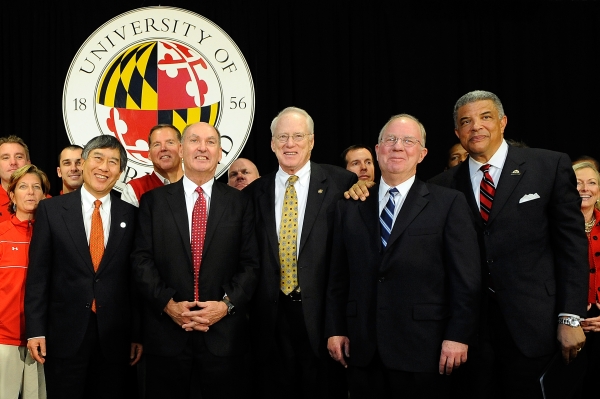
Exploitation of College Athletes Revisited: Maryland's move to the Big 10

On November 20th, the University of Maryland at College Park announced that it would be leaving the ACC (not a slouch of an athletic conference by most standards) and becoming part of the Big 10 Conference.  It was a curious move for all sorts of reasons (e.g. with the exception of Pitt & Penn St., Maryland is not a geographical neighbor to any of the other member schools of the Big 10), not the least of which being the way the decision was made and announced--the Board of Trustees started and finished the process in under three weeks and some regents weren't aware of the final decision until hours before it was announced to the media.  

Not surprisingly, finances played a big role in the decision and in providing a rationale for the move, Maryland President Wallace Loh made a rather interesting statement about Maryland's future potential to use the athletic department to subsidize other parts of the university (something many would call a pipe dream).  As reported in Inside Higher Ed, Loh has publicly declared that "substantial funds" from Maryland's new revenue stream as a member of the Big 10 Conference will be used to support the educational mission of the university, specifically through financial aid for needy students.  Loh then asserted that Maryland is "doing nothing less than developing a new financial paradigm for intercollegiate athletics."

On its face, Loh's statements and ideas seem laudable.  What could be better for college athletics than an institution where the athletic program, rather than being a drain on institutional resources, puts money back into the pipeline and for needy students, no less. However, viewed another way, this is just another example of athletes--specifically, those who participate in high-profile, revenue-producing sports (which at most institutions means football and men's basketball)--whose talent is used to bring prestige and financial gain to the larger institution.  What's more, writers like William Rhoden, would argue that systems such as the one Loh is advocating for, have historical echoes to early American History when African American men were oppressed for the benefit of the more privileged class of American society.  In his book Forty Million Dollar Slaves, Rhoden provides a narrative of black athletes in the US (who, make up the majority of athletes of high-profile teams in Div. I college athletics).  He describes the evolution of professional and collegiate athletics in the US as one that led black athletes from literal plantations--where sports were used as a distraction to quell uprisings among slaves--to symbolic plantations where professional sports franchises and intercollegiate athletic departments continue to exploit black athletes' skills.

Critics of the views put forth by Rhoden and others are quick to point out that high-profile scholarship athletes receive scholarships that cover tuition, books, room, board, and virtually any other expense they might incur directly related to their enrollment in the institution.  Further, by providing opportunities to black athletes (often from urban areas and familial cultures where higher education isn't the norm) to attend college, the institution does much more than give someone a chance to play basketball, they change his life trajectory.

My purpose here isn't to argue for one position or another, just to raise some interesting questions about college athletics in general, and Wallace Loh's views in particular.  Is a free college degree and the opportunity for a better future enough "payment" for what an athlete (or team of athletes) brings in for a university?  And, how often does the four-year athletic scholarship really lead to the opportunities cited by proponents of big-time college sports?  What does it mean for one student (or group of students) to subsidize the cost of enrollment for another group of students?


Friday, March 16, 2012

How good does someone have to be to earn a free pass when they're bad?

Earlier this week, one of the top stories in Provo, UT (where I live and work) was the Provo School District's suspension and planned termination of a popular football coach at one of the local high schools.  It is a sad story on a number of levels:  at least one person (and probably more) will likely lose his job, students and athletes at the school will have to deal with a number of distractions for the rest of the academic year, community members are upset, and public education (especially athletic departments at public institutions) has been given another black eye.  As I watched things play out over the last week, I couldn't help but think back to the Penn St. sex abuse scandal that dominated the media a few months ago.

Obviously, financial misdeeds seem incredibly benign juxtaposed with sexual abuse of children; however, there are some interesting parallels.  Both stories seem to illustrate a more general archetypal pattern of the fallen sports hero.  These stories contain a number of common elements.  First, the hero (usually a player or a coach, although in some communities some kind of athletic administrator may rise to this position) emerges through his (I use that pronoun intentionally here because I can't think of a fallen sports hero that isn't a male) consistent on-field success, contributions to the community (e.g. mentoring of young athletes, improved community morale around a winning team, charitable work, etc.), and general likability or charisma.  Note that this rise occurs over a number of years as in order to be considered a hero (rather than a one-season wonder) the character must establish an athletic dynasty, build a following in the community, and demonstrate (especially to those critics of traditional athletic culture) a level of integrity and commitment worthy of others' admiration.

The conflict in the story comes when the hero falls.  Although losing seasons may be part of this fall, losing alone isn't enough to qualify a narrative as a fallen sports hero story, because at their core, these are stories of betrayal and lost hope.  As much as we love our teams, we don't feel betrayed when they lose (in fact, the most die-hard fans increase their loyalty when losses pile up--do you know any Cubs fans?), just disappointed, frustrated, or maybe even angry.  Heroes fall when something disturbing happens in the overlapping space between their personal and professional lives, and we as their admirers are forced to confront a discrepancy between their actions and our idyllic image of them as societal models.  They break the law, mistreat individuals in their personal life, or in some other way act counter to the values we have previously believed they exemplified for us.  And, we are left feeling betrayed, hurt, and wondering if there is any good left in the world.

There are at least two typical responses at this point in the story.  First, athletic skeptics (and new believers who were once skeptics of athletics) use the fall as justification for their beliefs that athletics has nothing positive to contribute to the world (e.g. "All successful coaches cheat and lie and hot-shot players are entitled jerks who take what they want").  The other response, which is the more interesting one of the two, takes the form of praise for all the hero has done for the community and a profession of faith in the innocence and continued goodness of the hero.  This type of response is evident in a statement made by prominent author Stephen Covey, in support of Provo's current embattled sports hero:


"I believe in Coach Louis Wong. He is so much more than just a football coach. He represents Timpview      and he stands for excellence. He is as fine a man and leader as I know."


Another example from the hero's attorney:


 "What Lou did for the school and community went far beyond the field of play.  What he did is what we want our educators to do — care about the kids who are entrusted to their care, to help them, to teach them to make the right choices, to be team players, to cooperate and to work for what they get." 


While much of what is contained in these statements is probably true--I don't doubt that the coach really did care about students and players or that he possesses tremendous leadership skills--they make no attempt to address the wrongdoing.  Instead, they seem to imply that, because of the hero's long record of good deeds and established reputation as a good citizen, it isn't possible that he could be guilty as charged.  The same type of response was apparent in the Penn St. scandal as well when Paterno supporters criticized his termination by providing long lists of his good deeds (again, supporters rarely addressed the validity of the actual charges, just provided character references and expected that to be enough to clear him).  Beneath all of this rhetoric seems to be a belief that heroes', through their good deeds and exemplary lives, earn "free passes," that society is then obligated to accept as payment for wrongdoing.  

I don't know whether Louis Wong is completely innocent, just naive, or guilty.  We'll probably never know, and to give him any one of those labels would probably be overly simplistic.  However, it would be helpful if more of us were willing to admit that our heroes are usually both heroic and flawed as evidenced in this statement from Bob Gentry, interim Superintendent for the Provo School District:

"It’s extremely gut-wrenching and heartbreaking.  I know Coach Wong personally, and I think he’s a good man. I personally think he didn’t have criminal intent, but he made mistakes and we can’t ignore those mistakes." 


What would really be heroic in all of this would be for everyone involved to be completely honest about mistakes that were made.  That would include Wong as well as the former principal at the school, district officials, parents, assistant coaches, and anyone else involved.  But, that would be a fairy tale.


Friday, July 29, 2011

Can good people make it in corrupt systems?

In a recent post, I wrote about situational forces and the impact they can have on individual behavior.  The argument made is that good people can do terrible things under the right (or wrong) circumstances.  On Wednesday, this became a little more personal to me when a Provo City Council member, who is also one of my neighbors, was charged with 10 felonies relating to his dealings in local real estate development.  He isn't a next door neighbor and I've never been to his home, but I see him once a week or so and always got the impression that he was a pretty good guy--not someone I would take for a felon or defrauder.  The saddest part of it all is that he has a wife and young children that now have to deal with the fall out and find a way to hold a family together.  

I have no idea how much truth there is to the claims being made and don't care to make any kind of judgment.  It's just a sad situation and one that has brought me back to a question I have wondered about off and on over the years:  Can good people survive in systems or environments that seem to incentivize unethical and corrupt practices.  I first began asking this question as a new voter trying to make informed ballot decisions.  I saw the media regularly uncovering corrupt politicians and started to wonder if candidates in any very visible election or anyone in high profile public positions could hold on to their values and integrity.  As a student in an introductory political science class I asked this question of my professor (mostly because he gave us extra credit for visiting him during office hours).  After beating around the bush a little, he eventually told me that, no, he didn't think very many politicians stayed 100% honest (which is a little ironic given that until just a few months ago this professor was the chair of the Utah County Democrats now the chairman of the Utah County Democratic Party) and most compromised on their values.  Even as a fairly dense adolescent, I was a little shocked and pretty discouraged by his response.  And, voting that November wasn't as much fun as I thought it would be.

It would be unfair to paint all politicians or all business people as dishonest, but the reality is that those who work in these environments are often under extreme pressure to produce results, be it a victorious campaign or great quarterly report.  Similar pressures exist for professional and high profile collegiate athletics, some branches of academic research, and plenty of other settings as well.  And, because we are increasingly becoming a society which values "results" above all else (and, by results, we usually mean things that are easy to measure like profits, votes, and wins), we create systems that reward "producers," sometimes at the cost of values, relationships, and community.  

In my heart of hearts I know that there are plenty of good politicians, CEOs, and sports executives that are successful and upstanding.  But, I wonder how rare they are becoming and how many of them we'll see 10 or 25 years from now.  

Friday, March 11, 2011

When ideals and viability collide

On Tuesday evening, the Provo School Board approved a renovation of the Provo High School football complex.  Anyone who has driven by the stadium knows that this sort of project is long overdue, particularly when Bulldog stadium is compared to its neighbor up the hill at Timpview High School.  The challenge for Provo School District is how to fund capital projects like this one, in the face of ever shrinking budgets and a reeling economy.  Not surprisingly then, Tuesday evening's conversation about the renovation at Provo High was dominated by talk of where the money will come from.  The Board of Education has committed $125,000 on the front end of the project and has agreed to subsidize the cost of replacing the track that surrounds the field, but falls far short of the nearly $1.5 million that is needed for the two proposed phases of the project. The Board's solution?  Sell the naming rights for the stadium and field to the highest bidder.

At first glance something like this seems like a fine idea and common practice in the world of sports.  After all, we could probably all rattle of a list of 5 or 10 athletic venues named after corporations (e.g. The Staples Center in LA, The TD Boston Garden, or Energy Solutions Arena in Salt Lake City).  The sense among Board Members on Tuesday was that everyone wins.  The district brings in a large sum of cash, student-athletes have a great venue to play in, community members have something to be proud of, and a local business gets publicity.  But, it seems like a slippery slope to me and one that leads down an increasingly problematic path where, eventually, educational ideals are likely to be compromised (as evidenced by this extreme case from a Sacramento School District).  Of course, community businesses have always been partners with local schools when it comes to athletics.  They hang banners at the fields, have their names in the program, and donate goods at reduced cost for concessions.  But, in large part, it avoids major problems and conflicts of interest because of its scale.  The banners are for the gas station down the street, the concessions come from the local grocery store, and the programs are paid for by the trophy shop around the corner.  In other words, the money put up is small and those contributing are people that have at least a small stake in what happens at the school on Friday nights.

Provo District, however, is headed down a different path by asking for million dollar donations.  That sort of invitation brings in a much different bidder--one with deep pockets no doubt, but whose intentions aren't likely to be as pure as the burger joint down the road whose owners have had children and grandchildren don jerseys for the school.  When asked who his potential donors were, JT McGraw (the driving force behind the project) mentioned that Frontier Airlines would be at the top of his list.  It's a savvy move considering their the airline's recent announcement, but one has to ask how much Frontier airlines really cares about Provo High athletics.  And, in addition to their name on the stadium, what else might they want to see happen in exchange for their donation?  Half-time announcements?  Frontier's logo on the jerseys?  Where does it stop?

Those, of course, are all extreme examples.  But in thinking through these sorts of partnerships, schools need to consider where they might lead.  The next time the library needs a remodel, do we end up with the Subway Social Sciences shelf or the Domino's Pizza study hall?  And, based on the view of Board Member Darryl Alder--who commented that the district should try to sell naming rights for anything and everything it can--that sort of thing isn't out of the question.  

Even in college athletics, where corruption and profit-driven decisions are almost the norm, institutions have largely avoided corporate naming rights for their venues.  Most have distinct names, completely removed from individuals or corporations (e.g. The Cotton Bowl, The Rose Bowl, Harvard Stadium, and the "Big House" at Michigan).  Even when the stadium does have a namesake, it is almost always an individual or family who, while donating large sums of money, is a key part of the community in those places (e.g. Rice-Eccles Stadium in Salt Lake City, Heinz Field in Pittsburgh, or Doak Campbell Stadium in Tallahassee).  

So, the question Provo needs to ask is where this is all leading and if they'll really end up in a place that they want to be in.  Sometimes giving up a bit of money, in the name of doing what is best for students (like this community college in Texas) is a better road.


On

Friday, January 28, 2011

What is the role of "amateur educators?"

The Utah State Legislature began its 2011 session recently, which has meant a fair amount of media coverage of what sorts of legislation might be proposed during over the next couple of months.  One interesting (and pretty controversial) bill proposed by Senator Chris Buttars has centered around the question of who should have control of public education.  Buttars believes that local school boards and the State Board of Education have too much control and wants to shift more power into the hands of the legislature and the governor.  While part of the debate has to do with how money is spent and how to make schools and districts accountable for the use of tax monies, there are also questions about what should be taught in schools and how it should be taught.  

Arguments over who should hold the lion's share of the power over what happens in schools (i.e. legislators or school boards) is interesting  because neither group has much formal training or experience in education.  Granted, there are current and retired educators found on school boards and in state legislatures, but they are surely a small minority.  The bulk of these groups are business people, attorneys, physicians, farmers, homemakers, and others who in some sense become amateur educators with a great deal of influence over what happens in schools.  

There are plenty of good reasons for this to happen.  For the most part, we are a country who believes that education matters and that we all have something to gain from having an educated citizenry.  Consequently, educational issues are seen as impacting all of us, whether we are parents of school-age children, educators employed in the system, or just concerned citizens.  And, because education matters for all of us, we are all given some voice in what happens in schools.  We vote for state and federal politicians who enact educational policy and carry it out.  And, we vote for local school boards who have influence over issues more close to home.  This happens even more often outside of the traditional public school system where we see charter and public school boards made up of non-educators who are interested in what happens in their schools.  

We structure things this way, in part, based on the belief that the "crowd is wise" and that inviting participation from a large and diverse group of people can improve decisions and systems.  The tension it creates is determining when to involve "the crowd" and when to ask educators to apply their expertise to educational problems.  I don't have an answer, but it seems like an important question to raise and discuss.  For example, how much influence should the seven member Provo School Board (an attorney, a college student, a businessman, a businesswoman, and three homemakers) that represents the school district where I live have over curricular and pedagogical decisions?  And, when do the insights and unique perspectives of individuals outside of education bring innovation and improvements that wouldn't have been reached otherwise?

Friday, September 17, 2010

The dangers of zealotry & ideology

"The spirit of which I speak creates imaginary and magnifies real causes of complaing; arrogates to itself every virtue--denies every merit to its oponents; secretly entertains the worst designs . . . mounts the pulpit, and, in the name of a God of mercy and peace, preaches discord and vengeance; invokes the worst scourges of Heaven, war, pestilence, and famine, as preferable alternatives to party defeat; blind, vindictive, cruel, remorseless, unprincipled, and at last, frantic, it communicates its madness to friends as well as foes; respects nothing, fears nothing."

This is an excerpt from an 1830 Senate speech given by Edward Livingston in which he spoke critically of the reflexive partisanship and unreflective ideologies that were manifesting themselves in the debates about states' rights.  Livingston, who was a close political ally of Andrew Jackson and who like Jackson believed in the inherent goodness and wisdom of the American populace, was discouraged by the lack of civility, informed discourse, and thoughtfulness he saw in the political conversation of the period.  At the risk of an oversimplification, Livingston believed that people could make wise political decisions, but that uncivil, ideological debates prevented the wisdom of the citizenry from winning the day.  

When I read this part of Livingston's speech last week (in Jon Meacham's biography of Andrew Jackson, American Lion) it resonated with me because I see a lot of the same sort of thing today (maybe it has always been a part of large societies?).  Of course I thought immediately of the political realm and the unbending ideology that is part of every election cycle.  But, I also see it in education.  There are the qualitative & quantitative wars within research circles, the acquisitionists vs. the participationists in the learning sciences, and of course the behaviorists vs. the cognitivists vs. the constructivists.  Differences of opinion are a good thing, but only if those that hold those varying positions can engage with one another in civil and productive ways.  And, there is less and less of that happening these days.

Pluralism, be it theoretical, political, or practical is a good thing.  Communities can thrive when they are made up of diverse individuals who see the world from a variety of perspectives.  But, that outcome is only possible when we can engage in thoughtful dialogue with one another and use this diversity to work towards common purposes and, whenever possible, an enriched shared understanding (see James Surowiecki's The Wisdom of Crowds for a great treatment of this and related ideas).  In fact, the tension created between conflicting ideas can be powerful when it protects against excess, extremism, etc.  When two (or more) positions compete for attention and screen each other for weaknesses, we have a much better chance of arriving at some sort of critical understanding that is useful in guiding policy, practice, or behavior.  But, we have to listen to each other long enough, closely enough, and open-mindedly enough before we'll ever get to that point.  

I saw a good example of this (on a micro-level) recently when I attended a meeting of the Provo City School District Board of Education.  One of the agenda items for the board's study meeting was a proposal for the district to contribute some of its property tax revenue to the development of a parking structure for the Provo Freedom Plaza.  The board was fairly split and, from what I could infer, felt quite passionately about the issue.  There has been some history of less than outstanding real estate deals with Provo city in the past and some board members felt like the district had been burned.  Others felt strongly that the board should support the project because of its potential to bring money back to the district in ten years and because of the projects potential positive impact upon the city.  Initially, the discussion was quite heated, but I was impressed with board members' ability to put their passions and biases aside and listen to one another.  The final vote in the business meeting later on in the evening was still split, but at least two board members who were initially quite passionate in one direction or the other had changed their stance by the time the final vote was called for.  It was gratifying to see elected officials who were able to listen dispassionately and be critical of their own views.  Ultimately, I think the board made the decision that was best for the city and best for the district.

If only there were more of this in other places be it the senate or academic conferences.